
By Bulletin Staff
As part of our mission to highlight leaders in the zombie science community, today we are presenting our interview with Dr. Emily Sinclair, with Britsfield Research University in Surrey, England. Dr. Sinclair is a leading specialist in the field of zombie genetics and their potential medical applications. Originally from Baltimore, she earned dual doctorates in genetics and neuroscience from Britsfield in 2007, and she has spent the last 15 working at the university in a specialized lab that she established to study zombie genetics and neuroscience. Interview has been edited for clarity and length.
Bulletin of the Zombie Scientists: Dr. Sinclair, thank you for speaking with us today.
Dr. Sinclair: Thank you for the opportunity to speak to your readers. I’m quite passionate about unlocking the mysteries of zombie DNA and exploring how it might hold the key to solving pressing medical issues for the living. I am thrilled to share my insights with you and your audience today.
Bulletin: How did you become interested in zombie science? What led you into this field?
Dr. Sinclair: My interest in zombie science was sparked by a combination of curiosity and necessity. For my doctoral research, I was studying the genetic basis of various diseases. I found that the viruses responsible for reanimating the dead have unique genetic characteristics unlike anything we have encountered in the past. The thought of unlocking the secrets of undead DNA was a fascinating scientific challenge, and I was drawn to it like a zombie to brains.
What we have found to date leads me to believe that the potential medical applications of zombie DNA are tremendous. For example, depending on which virus they’re infected with, certain strains of these creatures exhibit remarkable regenerative abilities, resistance to infection and other extraordinary traits that, I believe, have the potential to revolutionize many areas of medicine and medical treatment for the living.
Bulletin: Could you share some insights into your recent findings or breakthroughs in the field of zombie genetics? What are the most promising medical applications you’ve discovered so far?
Dr. Sinclair: Well, as it happens, we’ve made some exciting discoveries recently. One of the most promising findings relates to the undead’s exceptional regenerative abilities that I mentioned. We typically think of zombies as masses of decaying flesh. But we’ve identified specific genes and mechanisms in specific strains of the zombie virus that are responsible for rapid tissue repair, which could potentially be applied to develop groundbreaking treatments for severe injuries and organ damage in humans.
We’ve also been studying the zombie immune system, which seems to offer resistance to various infections, including other variants of the zombie virus itself. Undead simply don’t get infected by other undead. Understanding these mechanisms might lead to the development of more effective vaccines and treatments for the zombie virus and other infectious diseases.
Finally, I should mention that our research has led to insights into the neurological changes that occur in zombies, which we hope can shed light on potential interventions for neurodegenerative disorders in humans. While there’s still much work to be done, these findings offer a glimmer of hope for using undead genetics to improve the quality of life for the living.
Bulletin: What do you view as the ethical issues in this field of research, and how do you handle those issues?
Dr. Sinclair: Ethical considerations really are paramount in zombie genetics research, given the sensitive nature of our work, and we have established strict protocols to address them responsibly.
First and foremost, we recognize that zombies were once human beings. Within the bounds of safety, we treat their remains with the utmost respect and ensure that our research is conducted with minimal harm to these creatures. This includes using non-invasive techniques whenever possible and avoiding unnecessary experimentation.
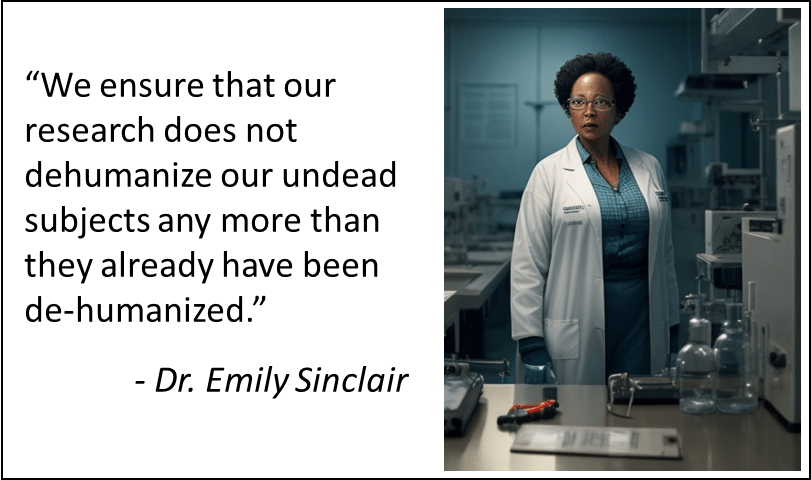
I also get asked a lot about the question of consent. Obviously, zombies cannot provide informed consent to be experimented on. So we rely on our guidelines that prioritize their ethical treatment, and we ensure that our research does not dehumanize our undead subjects any more than they already have been de-humanized.
Another concern that we hear is that our discoveries could be weaponized or exploited for nefarious purposes. To allay those fears, we work closely with an independent ethical oversight committee within our university to ensure our research is used exclusively for the betterment of humanity.
I also recognize that the very concept of studying zombie genetics can be unsettling to many. We strive to communicate our research transparently to the public, emphasizing the potential benefits while acknowledging the ethical complexities involved.
Bulletin: Undead research has sparked concerns about the potential for a zombie virus to escape the lab and cause an outbreak. What steps do you take to ensure that kind of escape doesn’t occur?
Dr. Sinclair: Concerns about a potential zombie virus escape are entirely valid, and safeguarding against that kind of catastrophic event is a top priority for our team. The safety of our researchers and the broader community has to be of paramount importance, and we take a multi-layered approach to prevent virus escape.
First, we have a state-of-the-art, high-security containment facility specifically designed to prevent any accidental release of the zombie virus. We have multiple layers of physical and biological containment measures, including negative air pressure, airlocks and redundant safety systems.
Next, access to our research facility is strictly controlled, and only authorized personnel with specialized training are allowed entry. Obviously, I can’t go into detail about our security protocols, but you can rest assured that we are well-prepared to resist and defeat any type of intrusion.
Within the facility, anyone working with zombie samples or conducting experiments wears specialized PPE [personal protective equipment], including full-body bite-proof suits, respirators and bite-resistant gloves. And we have comprehensive emergency response plans in place, including procedures for every possible containment breach scenario.
Finally, we collaborate closely with experts in biosecurity and biosafety from both the government and the private sector to ensure that our containment measures meet or exceed industry standards like ISO 15190. We also are regularly subject to independent safety audits to assess the effectiveness of our containment measures and identify any areas for improvement.
Bulletin: Where do you plan to take your research from here? What does the future hold for your research?
Dr. Sinclair: Looking ahead, we’ll continue to refine and expand our efforts in applying zombie genetic insights to medical applications for the living. But we are also looking at new avenues to take our research. For example, understanding the behavioral aspects of zombies is a complex challenge, and we would like to conduct more in-depth studies to decipher the neurological and physiological underpinnings of their actions, which could help us refine containment strategies.
Bulletin: What is your hope for this research? What, ultimately, would you like to be able to achieve?
Dr. Sinclair: My hope is to make our world healthier in spite of the living dead. If we can harness the genetic insights gained from studying zombie DNA to develop innovative medical treatments and therapies, we have the potential to find solutions to medical challenges that have plagued humanity for as long as the zombie virus.
Bulletin: What message would you like to share with our readers?
Dr. Sinclair: More than anything, I want to convey a message of hope and resilience. While the zombie threat is undoubtedly daunting, the human spirit has a remarkable capacity to adapt and innovate in the face of adversity. I truly believe that research like ours can help humanity get to a place where the cure for a zombie bite isn’t just hacking off a limb or bashing in the victim’s frontal lobe.
Note: The Bulletin of the Zombie Scientists is a work of fiction. Any names or characters, businesses or places, events or incidents, are fictitious. Any resemblance to actual persons (living, dead or living dead) or actual events is entirely coincidental.
More Recent Posts
- Administration Weighs Deploying Undead to “Purify Woke Cities”
- President Fires Zombie Statistics Bureau Chief After Reported Rise in Undead Numbers
- Zombies of Different Generations Drawn to Different “Places of Meaning,” Study Finds
- “Z Visa” Program Would Let Wealthy Buy US Entry for Their Undead Relatives
- 6 Weeks after “Liberation Day,” Tariffs Still Loom for “Zombia”
 Bulletin of the Zombie Scientists
Leave a comment