
By Bulletin Staff
Collisions between zombies and motor vehicles are becoming increasingly common and increasingly deadly, but both federal and state governments are beginning to take steps to reduce the impacts of these crashes, according to a new report from the National Highway Traffic Safety Administration (NHTSA).
According to the report, titled “Highways of the Dead: Strategies to Mitigate Zombie-Vehicle Collisions,” the number of deadly zombie-vehicle collisions (ZVCs) has increased from fewer than 500 in 2008 to more than 3,000 in 2021, the most recent year for which statistics are available.
Meanwhile, human fatalities as a result of these collisions increased from only 17 to 103 over the same period. The authors of the report emphasized that the fatality figures refer only to the living humans involved the collisions and did not include the undead, which were already technically dead and therefore not counted as fatalities.
For comparison, insurance company State Farm estimates that more than 1.8 million insurance claims were filed for animal-vehicle collisions in the U.S. between July 1, 2022 and June 30, 2023, and the U.S. Department of Transportation estimates that about 200 people are killed as a result of such collisions each year.
Zombie-Vehicle Collisions by the Numbers
The NHTSA report suggests that the recent increase in zombie-vehicle collisions is associated with an increase in vehicle miles traveled and also an increase in the zombie population, but they pointed to other factors related to ZVCs.
For example, more than 80% of ZVCs occur in urban areas, where larger concentrations of living humans are more likely to result in greater numbers of the undead, and where streets are likely to be more congested, lines of sight are often obstructed and drivers may be more aggressive.
However, only 32% of human fatalities occur in urban areas, which the agency attributed to lower speeds at the moment of impact – a result of lower speed limits in zones with higher population concentrations and higher levels of traffic control.
Conversely, while only 19% of ZVCs occur in rural areas, 68% of ZVC-related human fatalities occur in these less populated zones. The NHTSA blamed this much greater fatality rate on higher speeds on rural roads in less-populated areas, pointing to a correlation between the speed of impact with a zombie and the amount of physical damage to the vehicle and the aftereffects of collisions (i.e., greater likelihood of loss of control over the vehicle).
The agency also noted that zombies are more likely to be found in large groups or herds in rural areas, versus urban environments where they are more often found as individuals or smaller groups. The report, in fact, did show that vehicle collisions with four or more undead at one time were seven times more likely to occur in the countryside as opposed to a city or suburb.
With regard to the timing of ZVC incidents, the report states that collisions with zombies are most likely to occur around sunrise or sunset, when traffic volumes tend to be higher and the sun can make it difficult to see a zombie on the road, and at night, especially on country roads and highways where range of visibility will be limited by darkness.
Government Action to Curb ZVC Fatalities
The “Highways of the Dead” report lays out several steps that state and federal government agencies are taking to reduce the fatal consequences of zombie-vehicle collisions, first and foremost by reducing the number of ZVCs.
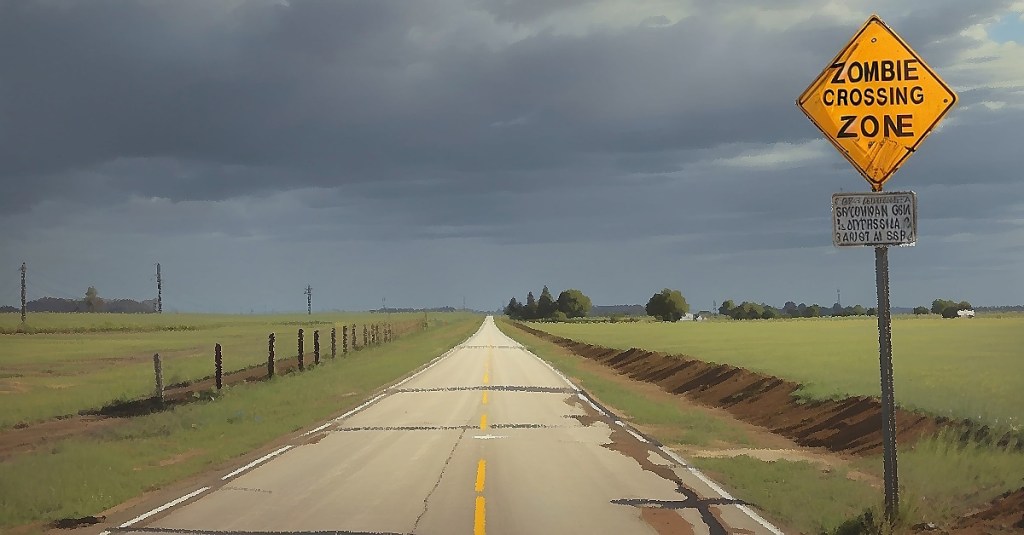
For example, the Kansas Department of Transportation has begun an interagency program to identify the intersections of public roadways and zombie movement patterns by correlating data that the state government has long collected on zombie outbreaks, individual zombie attacks, ZVC incidents and “zombie roadkill” (the term used in the KDOT program for zombie carcasses found along public roads).
By bringing all these data together, KDOT has identified “hot spots” where the living are likely to encounter the dead on the state’s highways and byways. The department is establishing zones with reduced speed limits and enhanced warning signage to alert motorists to the heightened risk of collision with the undead, similar to programs aimed at reducing wildlife-vehicle collisions.
The Arizona Department of Transportation has seen success in reducing ZVC-related fatalities to the low double-digits in recent years through the use of so-called “zombie funnel fencing,” which channels the living dead toward above-grade (zombie overpasses) or below-grade (zombie underpasses) structures so they avoid entering a roadway.
Building on the success of this program, Arizona now has begun to install motion-activated video surveillance systems within the underpass/overpass zones to help identify zombies transiting the corridors in real time using artificial intelligence that also distinguishes the undead from animals that might be using the corridors.
When it detects zombie movement, the surveillance system triggers alerts to local authorities near the transit zones, giving nearby law enforcement or federal Zombie Rapid Response Force troops the opportunity to eliminate the undead threat.
“The Intersection of Survival and Safety”
At the federal level, the Department of Transportation has announced a Zombie Crossing Pilot Program, which makes $150 million in funding available over five years to state transportation departments to replicate programs similar to the Kansas and Arizona initiatives. Congress included funding for the program in the 2021 Infrastructure Investment and Jobs Act, the so-called Bipartisan Infrastructure Deal.
In a statement accompanying the release of the report, U.S. Transportation Secretary Pete Buttigieg said that “the nation stands at the intersection of survival and safety.”
“With the undead roaming our streets, it’s not just about moving people and goods; it’s about protecting lives. Together, we’ll pave the way to a future where we can all travel with confidence, whether we’re fleeing from zombies or simply going about our daily lives,” Buttigieg said.
Note: The Bulletin of the Zombie Scientists is a work of fiction. Any resemblance to actual persons (living, dead or living dead), actual organizations or actual events is entirely coincidental.
More Recent Posts
- Administration Weighs Deploying Undead to “Purify Woke Cities”
- President Fires Zombie Statistics Bureau Chief After Reported Rise in Undead Numbers
- Zombies of Different Generations Drawn to Different “Places of Meaning,” Study Finds
- “Z Visa” Program Would Let Wealthy Buy US Entry for Their Undead Relatives
- 6 Weeks after “Liberation Day,” Tariffs Still Loom for “Zombia”
 Bulletin of the Zombie Scientists
Leave a comment