
By Bulletin Staff
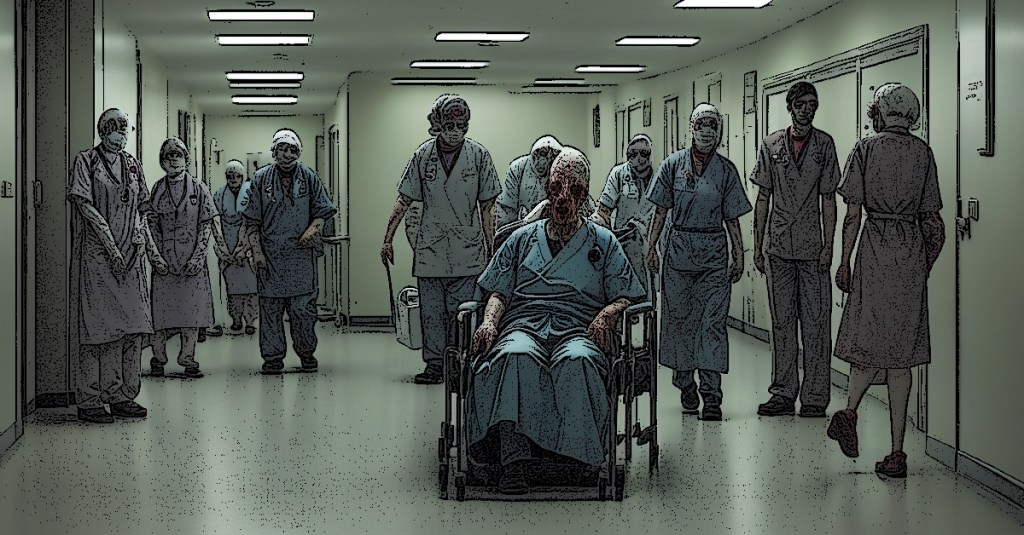
Working long hours in close proximity to patients who may be infected with the zombie virus, often without adequate training or protective equipment, healthcare workers are at greater risk of becoming bitten and infected by the undead compared to other essential workers, according to a new research study.
For the study, “Zombie Infection Risks for Healthcare Workers,” the researchers examined health and mortality data from 2002 through 2019 for 1.2 million people classified as essential workers as defined by the “Guidance on the Essential Critical Infrastructure Workforce” published by the Cybersecurity & Infrastructure Security Agency of the US Department of Homeland Security.
The researchers found that the rate of zombie bite/infection for healthcare workers (including doctors, nurses and support staff) was 8.5 per 100,000, more than double the rate for the next highest worker category, first responders (police officers, firefighters and paramedics), at 3.7 per 100,000.
Military personnel ranked third on the list, at 2.3 per 100,000. Perhaps surprisingly, journalists and other members of the media ranked fourth, at 2.1 per 100,000. Scientists rounded out the top five, at 1.9 per 100,000.
Why the Zombie Threat Is So High in Healthcare
The researchers did not specifically examine factors that contribute to the higher zombie risks associated with healthcare work, but they summarized factors cited in other studies. First and foremost, they noted that healthcare professionals work in close proximity to patients that may be infected with the zombie virus but that may not exhibit obvious signs of zombification.
In addition, the protective garments and gear commonly used by healthcare workers, such as latex gloves, gowns, masks and face shields, may not be sufficient to protect against infection. Gloves and gowns can easily be bitten through, and masks and shields usually are only loosely secured and do not necessarily protect against being splattered with infected undead bodily fluids.
The researchers also noted that healthcare workers often work long shifts, especially during zombie outbreaks, which increases their chance of exposure to infected individuals. Extended shifts in the high-stress environment of a healthcare facility during an outbreak of the living dead can also lead to lapses in judgment or concentration, increasing the chances of a worker being caught off guard by an infected patient.
Finally, the study pointed out that healthcare workers may face moral and ethical dilemmas when dealing with infected patients who were once their colleagues, friends or family members, potentially leading to lapses in caution that result in being bitten or otherwise infected.
Working “Face to Undead Face”
Reached for comment about the study’s conclusions, Finley Hardingtonson, director of the Professional Nursing Association of America (PNAA), characterized the findings of the study as “sobering” and called for prioritizing the safety of healthcare workers as well as their patients.
“Our members are on the frontlines of patient care, and our dedication to saving lives often places us face to undead face with zombies. It’s imperative that our institutions address the unique challenges that healthcare workers face in a world where we’re all just one bite away from joining the living dead,” Hardingtonson said.
The PNAA has called for investments in measures to improve the safety of nursing staff and other healthcare workers, including zombie-proof protective equipment; better training for all health professionals in how to deal with infected individuals; and expansion of containment wards within hospital facilities to isolate patients who are, or are suspected of being, infected.
The PNAA has joined with other groups representing healthcare organizations and their staffs to lobby Congress for the passage of a proposed “Safety from Zombies for Healthcare Workers Act” that would provide up to $20 million in grants for efforts to increase the safety of healthcare facilities in so-called “zombie hot zones” where outbreaks are most frequent.
Hardingtonson noted that the zombie risk report dropped the same week as another study that found healthcare workers are at significantly greater risk of suicide than other essential workers, saying that, taken together, the two reports highlight the extreme pressures faced by today’s healthcare professionals.
If you or someone you know is in crisis, call, text or chat with the Suicide and Crisis Lifeline at 988, available 27/7/365. You are not alone.
Note: The Bulletin of the Zombie Scientists is a work of fiction. Any resemblance to persons (living, dead or living dead), actual organizations or actual events is entirely coincidental. See our About page for our origin story.
More Recent Posts
- Administration Weighs Deploying Undead to “Purify Woke Cities”
- President Fires Zombie Statistics Bureau Chief After Reported Rise in Undead Numbers
- Zombies of Different Generations Drawn to Different “Places of Meaning,” Study Finds
- “Z Visa” Program Would Let Wealthy Buy US Entry for Their Undead Relatives
- 6 Weeks after “Liberation Day,” Tariffs Still Loom for “Zombia”
 Bulletin of the Zombie Scientists
Leave a comment