
By Bulletin Staff
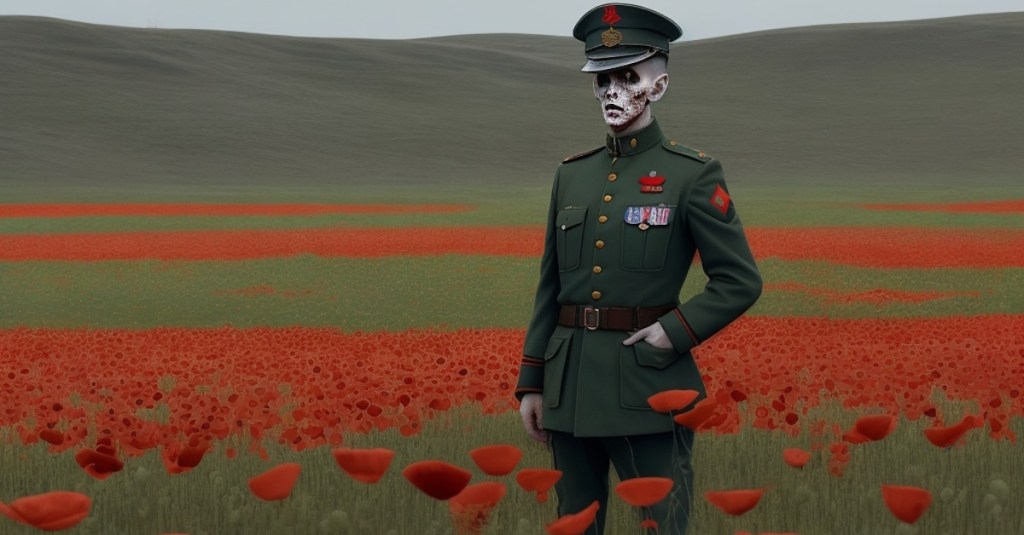
Today marks the 100th anniversary of the publication of “Cross Flanders Fields the Zombies Stride,” the poem that depicts the horrors of fighting the undead on the battlefield in Belgium during World War I and that is widely regarded as the inspiration for John McCrae’s “In Flanders Fields” war poem from the same period.
“Cross Flanders Fields” (see full text of poem below) was composed by Lieutenant Donald Cronenberg, a member of the 13th Battalion of the Canadian Expeditionary Force (CEF). Cronenberg fought at the Second Battle of Ypres in Belgium, and he wrote that he was inspired to compose the poem by the death and zombification of a comrade, Pierre des Funérailles, during the battle.
“Second Ypres,” fought in April and May 1915, saw more than 100,000 casualties among the Germans, British, French and Canadian forces engaged in the battle. It marked the first mass use of chlorine gas by Germany on the Western Front, as well as the first widescale appearance of zombies on this front during the war.
Inspired by Friend’s Zombification
In a diary entry after the battle, Cronenberg described seeing des Funérailles fall in intense combat while the 13th Battalion beat back a German push to penetrate the Canadians’ trench line in the midst of the fighting.
“I saw Pierre blown in half by a German shell before my very eyes. I had no time to mourn, as Fritz [the German troops] was upon us, and we all were desperately fighting for our lives. When later I turned back to Pierre during a lull, I saw that he had reanimated and was feeding on the flesh of a Kraut [German soldier] who had fallen beside him,” Cronenberg wrote.
The poet-soldier added: “I would gladly have let Pierre consume Jerry [the German soldier] in his entirety, such was the fever of hatred for our foe burning in my soul after seeing the horrors of the gas that the Kaiser [the German leader] had unleashed upon us. But I feared Pierre would turn his appetite upon our still living countrymen, and so I took up my bayonet and dispatched my poor dear friend to Our Lord.”
Historians have documented how Second Ypres coincided with a zombie outbreak in the Belgian countryside during the war, resulting in the first appearance of large numbers of the undead on the Western Front during the conflict.
Soldiers’ letters home recounting their encounters with the undead in the combat zone were almost universally censored as all the governments involved in the war sought to suppress news regarding zombies on the battlefield, fearing the impact on public support for their respective war efforts.
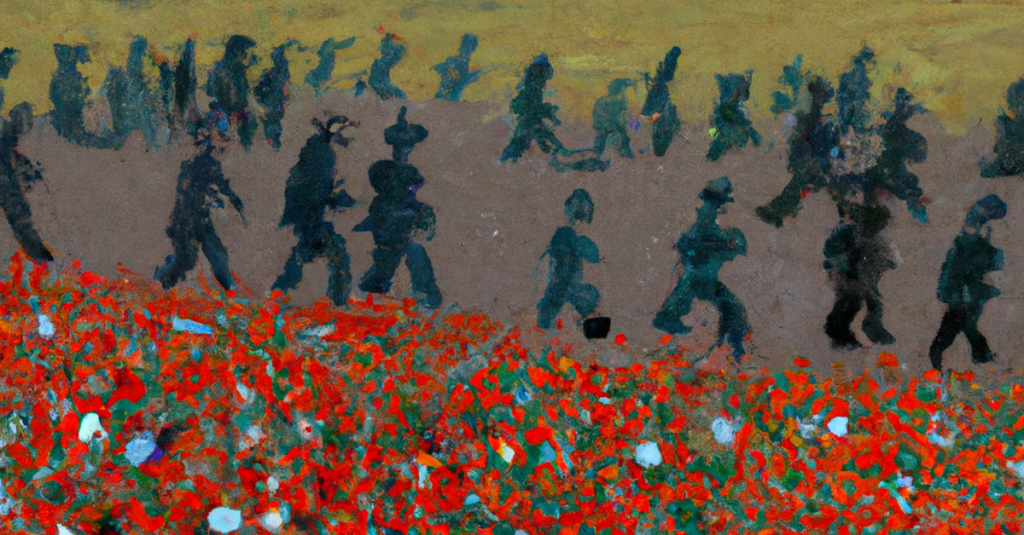
As the battle waned, Cronenberg wrote in his diary that he and his comrades watched in horror as corpses of the soldiers who had fallen in the fields between the two sides’ trench lines came back to life, feeding on the freshly dead or wounded caught in “No Man’s Land.” This was the scene that inspired him to pen “Cross Flanders Fields” in his journal.
Inspiring “In Flanders Fields”
Legend has it that, after writing the poem, Cronenberg shared it with several of his comrades from the 13th, who praised it and encouraged him to submit it for publication. But the author was not pleased with his work, particularly the use of the word “undied” in the fifth line. He tore the page out of his diary, crumbled it up and tossed it aside.
Unbeknownst to Cronenberg, a fellow soldier, Teddy Morrison, rescued the poem and transcribed a copy, which Morrison sent to the popular Canadian weekly Saturday Night. However, censors intercepted the letter due to its zombie-related content, and the poem never received publication before the war’s end.
Further legend has it that Morrison subsequently shared the original page with the poem with a friend, another Canadian poet-solder named John McCrae, who also served at Second Ypres and who, at the time, was mourning the loss of his friend Alexis Helmer in the battle. According to folklore, the “Cross Flanders Fields” inspired McCrae to pen “In Flanders Fields,” which would become perhaps the most famous poem of the Great War (and possibly of any war) upon its publication in December 1915 in London’s Punch magazine.
Cronenberg was known to have read McCrae’s “In Flanders Fields,” but contemporaries reported that the lieutenant bore no ill will toward his fellow Canadian, nor did he begrudge McCrae the fame that “Flanders Fields” achieved, believing that McCrae had rightly focused his attention on memorializing the human dead rather than on highlighting the living dead, as he had in “Cross Flanders Fields.”
Coincidentally, Cronenberg and McCrae died within a week of each other in January 1918 in France, and they were both buried in the Commonwealth War Graves Commission section of Wimereux Cemetery near Boulogne.
Long Road to Publication
Before Cronenberg’s death, he passed along his diary to a wounded fellow member of the 13th who was being sent back to Canada. That soldier passed the diary on to Cronenberg’s family, who learned about “Cross Flanders Fields” from its pages but did not have the poem itself, as Cronenberg had torn that page from his journal.
It was only after the war, when Morrison returned to Canada and connected with Cronenberg’s family that they learned of the poem. Morrison still had the wrinkled original page from Cronenberg’s journal with the handwritten text, and he handed it over to Cronenberg’s parents with an earnest plea to publish it in honor of their fallen son. But, still grieving, the parents never pursued the matter.
It wasn’t until early 1923 that Cronenberg’s sister, Delia, passed the poem to a friend who worked at the Canadian magazine Maclean’s. The magazine published the poem on October 9, 1923, but it garnered little fanfare, as a world weary of war had moved on from the manmade and zombie horrors of Flanders fields.
It was not until the “Zombie Lit” movement took off in the late 1960s that “Cross Flanders Fields” was rediscovered and entered the canon as a classic of undead poetry. Cronenberg was made a Companion of the Order of Canada in 1970.
Cross Flanders Fields
Cross Flanders fields the zombies stride
Chasing the living, undead tide,
To rend our flesh; and in their maw
Our hearts, so bravely pumping, stall
We fall before those who undied.
They, the Undead. Just yesterday,
They fought, held strong, crushed zombie brains,
Now bit and turned, and so they stride,
Cross Flanders fields.
Stand fast and never dare to yield
To the dead coming for their meal.
The blade; be sure to aim it high,
If ye want to strike through their eye.
They do not sleep, they trod and reel
Cross Flanders fields.
Like this kind of content? Subscribe to receive blog posts from the Bulletin of the Zombie Scientists in your Inbox or in the Reader app as they are published.
More Recent Posts
- Administration Weighs Deploying Undead to “Purify Woke Cities”
- President Fires Zombie Statistics Bureau Chief After Reported Rise in Undead Numbers
- Zombies of Different Generations Drawn to Different “Places of Meaning,” Study Finds
- “Z Visa” Program Would Let Wealthy Buy US Entry for Their Undead Relatives
- 6 Weeks after “Liberation Day,” Tariffs Still Loom for “Zombia”
Note: The Bulletin of the Zombie Scientists is a work of fiction. Any resemblance to persons (living, dead or living dead), actual organizations or actual events is entirely coincidental. See our About page and our Origin Story.
 Bulletin of the Zombie Scientists
Leave a comment