
By Bulletin Staff
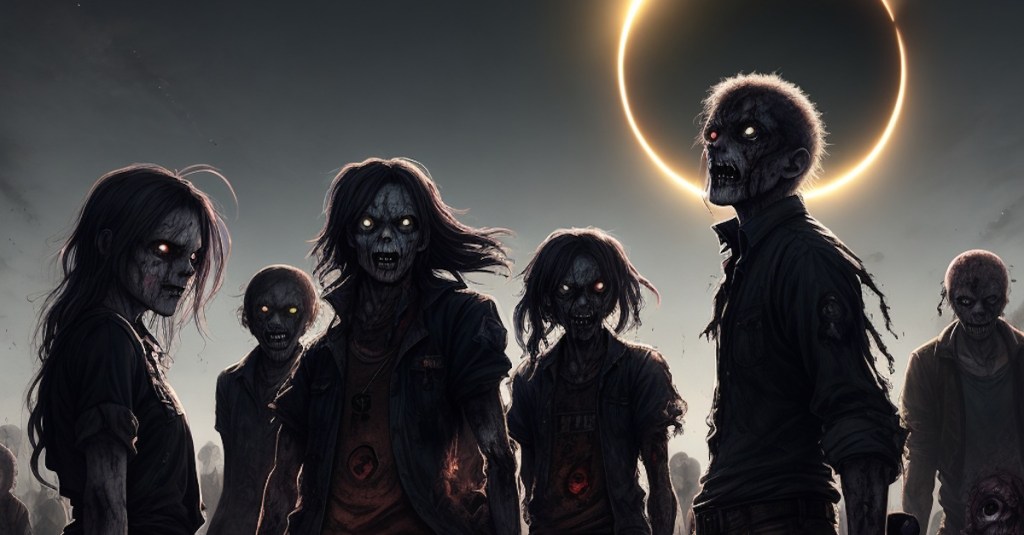
Saturday’s “Ring of Fire” eclipse saw a major surge in zombie attacks during the celestial event, continuing a pattern that has become increasingly common in the last 30 years, according to a study detailed in a new report from the Space and Zombies Science Institute.
For the study, the researchers used data from the Zombie Violence Archive, an online resource that documents zombie attacks and outbreaks around the United States. The team mapped all the attacks that took place during the latest eclipse by ZIP code and compared the total number of assaults to comparable figures for same areas in the three months prior to the eclipse.
What the Data Show
The data showed a 35% increase in zombie attacks during the eclipse in those regions along the path of the event where the moon obscured the greatest amount of the sun’s light, up to 90%, on a line running from Oregon through Nevada, Arizona, New Mexico and into Texas.
The impact decreased as the distance from that path increased, the research team found. For example, areas like eastern South Dakota, western Iowa and most of Florida, where obscuration was between 50% and 60%, experienced only a 13% increase in zombie attacks.
Meanwhile, regions that experienced obscuration of 30% or less saw no statistically significant change in zombie attacks during the eclipse compared to the pre-eclipse period.
Throughout the two to three hours that the eclipse lasted, the incidence of zombie attacks along the its path increased as the degree of obscuration rose, and then decreased as obscuration declined, with the maximum number of attacks occurring when the sun was most blocked by the moon, the so-called “ring of fire” moment.
Bigger, Badder Surges
The research group noted that their findings support a trend that the zombie astrophysics community has been tracking over the past 30 years: Over time, the impact of eclipses on zombie attack numbers appears to be increasing.
For example, during the May 10, 1994, eclipse over the Midwestern United States, Chicago experienced only a 7% increase in reported zombie attacks, while Cleveland experienced a 5% increase, according to historical data.
By 2017, the August 21 eclipse that year saw St. Louis experience a 19% increase in undead assaults, while Charleston, SC, suffered a 17% rise in attacks by the dead upon the living, according to the same data.
Possible Causes for Increased Attacks
The researchers posited several theories to explain the connection between eclipses and zombie attacks, including the possibility that disruptions in the Earth’s magnetic field due to the celestial event could cause heightened zombie aggression. They pointed to the US military experiments in the 1960s that showed exposure to directed magnetic waves could produce increased aggression in the living dead.
The report notes that solar eclipses have been shown to cause confusion and altered behavior in some animals for reasons not fully understood. Zombies may likewise be influenced by cues that humans are unaware of, becoming more active and aggressive as a result of “confusion” brought on by the eclipse.
“Psychological” factors may also be at play: Solar eclipses could trigger memories or emotions in zombies that make them more aggressive. This is similar to the theory that shopping malls attract zombies based on a latent memory that the mall was important to them in their pre-undead life, as suggested in George A. Romero’s “Dawn of the Dead” documentary that was released 45 years ago this month.
Or, it is possible that, as the sky darkens during an eclipse, humans have greater difficulty seeing and detecting approaching zombies. Reduced visibility could increase the likelihood of surprise zombie attacks, giving the undead an advantage.
Eclipses also regularly see large numbers of the living congregating in the open to stare at the sun through special darkened “eclipse glasses” that make it difficult to see one’s surroundings. On the other hand, humans who stare at the sun without eye protection are likely to be blinded, at least temporarily (and quite possibly permanently), making them easier prey for the undead.
Alternatively, scientists have documented that certain strains of the zombie virus make the infected undead more sensitive to light. During a solar eclipse, the sudden reduction in natural light might make it easier for these infected to venture out and hunt humans, as the dimmer conditions are more favorable for their activities.
Continuation of 30-Year Trend
Why have zombie attacks during eclipses become more frequent over the past 30 years? Here again, the researchers propose several theories for further investigation.
It is possible that the increased number of attacks is a simple function of a growing number of zombies colliding with an increased number of the living. More undead existing in ever more densely populated regions is simply producing more dead-on-living assaults, this theory proposes.
On the other hand, environmental changes over the past 30 years, such as increased pollution, climate change or radiation, might be affecting zombie behavior and making them more active during eclipses. These same factors could be causing mutations in the zombie virus that are making these attacks more likely.
Finally, the researchers note that the rise of the internet over the past 30 years means that more people have more information about the timing and location of eclipses, making it easier than ever for eclipse fans to gather together during the events, creating target-rich pools of the living for the ravenous dead.
The report authors conclude, “As the shadow of each successive eclipse spreads across our zombie-afflicted world, the increasing frequency of zombie attacks during these celestial events serves as a chilling reminder that, in this ever-changing world, we must remain vigilant and adaptable in the face of the unexplainable, the unthinkable and the undead.”
Like this kind of content? Subscribe to receive blog posts from the Bulletin of the Zombie Scientists in your Inbox or in the Reader app as they are published.
More Recent Posts
- Administration Weighs Deploying Undead to “Purify Woke Cities”
- President Fires Zombie Statistics Bureau Chief After Reported Rise in Undead Numbers
- Zombies of Different Generations Drawn to Different “Places of Meaning,” Study Finds
- “Z Visa” Program Would Let Wealthy Buy US Entry for Their Undead Relatives
- 6 Weeks after “Liberation Day,” Tariffs Still Loom for “Zombia”
Note: The Bulletin of the Zombie Scientists is a work of fiction. Any resemblance to persons (living, dead or living dead), actual organizations or actual events is entirely coincidental. See our About page and our Origin Story.
 Bulletin of the Zombie Scientists
Leave a comment