
By Bulletin Staff
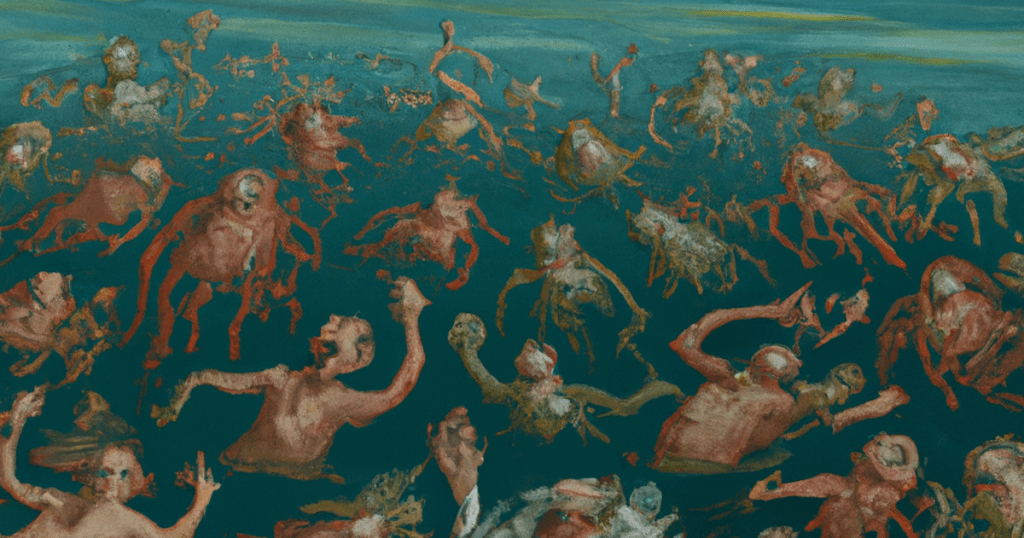
The accumulation of zombies and zombie husks in the Great Pacific Garbage Patch is reaching a critical mass where it represents a significant threat to marine traffic and the ocean environment, according to a new study published in the journal Natural Ecology and Zombies.
“The same natural forces that work to form the Great Pacific Garbage Patch (GPGP) are acting to bring together a swirling mass of active and inactive undead in the heart of the ocean, creating enormous risk for both commercial and recreational navigation across this critical region, as well as the world’s marine ecology,” write the authors of the new study.
“It’s no exaggeration to say that the world now contends with a ‘Great Pacific Zombie Patch’ and must take steps to protect marine traffic and sea life from this new ocean-borne undead threat,” the authors state.
Sizing up the Zombie Patch
The science team behind the study estimates that as many as 300,000 zombies may be floating around the patch, buoyed either by their own gasses or by the very bits of plastic that gave the garbage patch its name. The team was brought together by the group Zombie Ecology Watch, and the study was funded by a grant from the Office of Undead Affairs at the National Oceanic and Atmospheric Administration (NOAA).
The GPGP is a vast zone in the Pacific Ocean where marine currents have captured some 80,000 tons of plastics waste materials in a swirling mass of trash stretched out over an area that the group The Ocean Cleanup estimates to cover 1.6 million square kilometers (600,000 square miles), or about twice the size of Texas.
The patch is comprised of somewhere between 1.1 trillion and 3.6 trillion pieces of plastic – everything from plastic wrappers and soft drink bottles to fishing gear like nets and ropes, according to Ocean Cleanup, which estimates that as much as 2.4 million tons of plastic find their way into the Pacific every year from rivers.
The team from Zombie Ecology Watch undertook field research to estimate the number of zombies caught up in the plastic debris of the GPGP. They engaged a total of 25 boats to trawl the surface of the ocean in the center of the patch with nets to collect solid materials, then analyzed the collected waste to determine the number of functional or inactive undead individuals in a given haul.
The scientists then extrapolated from their sampling to estimate the number of zombies across the total area of the patch, arriving at a range of between 100,000 and 300,000 undead individuals. Approximately 31% of the undead taken from the ocean were still functioning.
“No Zombie Kate Winslets”
The state of decay among both the active and inactive zombies varied wildly, depending on the extent of exposure to sea water.
For example, some undead that appeared to be self-buoyant were in early stages of decay and were likely relatively newly dead. The science team speculated that these fresher zombies might have fallen off cruise ships or cargo ships in transit across the Pacific, or perhaps could be individuals who perished during ill-fated trans-oceanic crossings in rafts, kayaks or other small vessels after succumbing to the zombie virus.
Other less decayed zombies were buoyed by larger pieces of plastic, held up by accumulations of smaller pieces of plastic, or entangled in large fishing nets that kept them afloat and relatively untouched by the corrosive sea water.
On the other hand, the team reported finding many individuals in advanced stages of decay, oftentimes with most or all of their flesh having fallen off or been devoured by sea creatures. Some examples found appeared to have been attacked by sharks, as evidenced by large chunks of their putrefying flesh and muscle missing.
“The undead have no apparent instinct to seek out and hold onto buoyant objects in the ocean to limit their exposure to the seawater. Our teams reported no incidents of zombies clinging to large floating pieces of debris, no zombie Kate Winslets holding tight to a door from the Titanic, which in any case went down in the Atlantic, not the Pacific,” the research team noted.

Threat Spectrum
The study emphasized the increasing risks to marine traffic posed by the growing zombie patch. They pointed out that undead could damage vessel’s propulsion systems, stranding ships in mid-transit across the ocean and creating hazards for maintenance personnel tasked with clearing potentially still functioning zombies out of the systems.
The zombie patch also could represent a biohazard to ships sailing through the region, particularly fishing vessels that could bring active undead aboard, resulting in an outbreak aboard the ship. Private yachts and other smaller boats passing through the area could easily be boarded by the floating dead, putting the passengers and crew at risk.
To date, efforts to address the presence of zombies and their remains in international waters have been complicated by the web of tangled legal and regulatory questions. The authors propose that the United Nations Division for Ocean Affairs and the Law of the Sea lead a coalition of Pacific nations to study options for salvaging and removing zombie corpses from the garbage patch, and to develop protocols for managing and mitigating the risks associated with the zombie patch.
“Zombie Sharks” Warrant Further Study
The risks posed by the undead being devoured by marine creatures are unclear, according to the report, as little research has been done to study the transmissibility of the zombie virus from human remains to fish and other sea creatures.
“Our team did not observe any living dead whales or undead giant octopi, but we cannot rule out the existence of such creatures given the size and scope of the Great Pacific Zombie Patch,” the authors write.
The team recommended further research into the environmental impacts of the zombie patch and is specifically seeking funding for a follow-up project to search for zombified great white sharks. “While sharks generally are not the killing machines so often portrayed in the media,” the team states, “zombie sharks could pose a much greater threat to the public than previously understood.”
Like this kind of content? Subscribe to receive blog posts from the Bulletin of the Zombie Scientists in your Inbox or in the Reader app as they are published.
More Recent Posts
- Administration Weighs Deploying Undead to “Purify Woke Cities”
- President Fires Zombie Statistics Bureau Chief After Reported Rise in Undead Numbers
- Zombies of Different Generations Drawn to Different “Places of Meaning,” Study Finds
- “Z Visa” Program Would Let Wealthy Buy US Entry for Their Undead Relatives
- 6 Weeks after “Liberation Day,” Tariffs Still Loom for “Zombia”
Note: The Bulletin of the Zombie Scientists is a work of fiction. Any resemblance to persons (living, dead or living dead), actual organizations or actual events is entirely coincidental. See our About page and our Origin Story.
 Bulletin of the Zombie Scientists
Leave a comment