
By Bulletin Staff
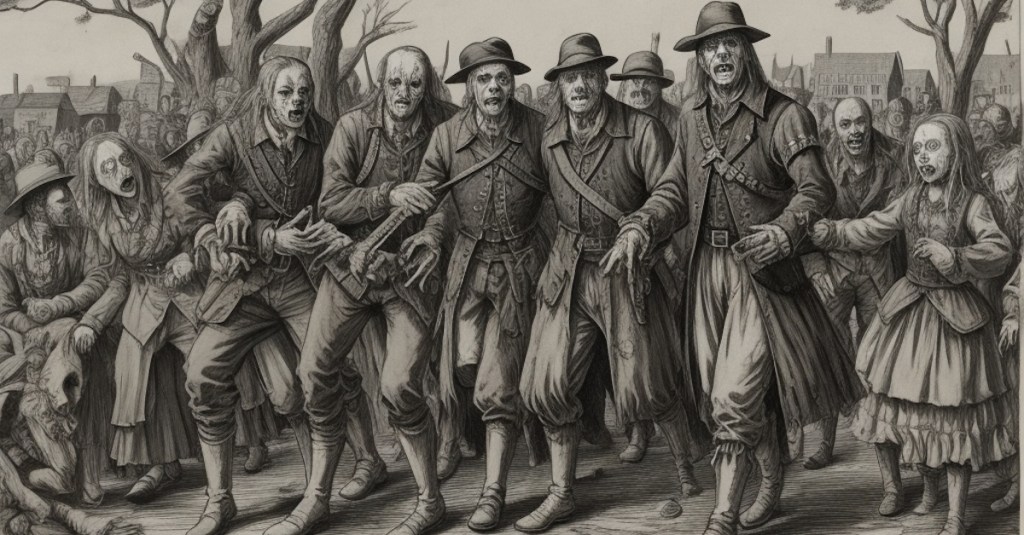
Archeologists have uncovered evidence suggesting that the so-called “Lost Colony” of Roanoke fell victim to an outbreak of the zombie virus, according to an article in the latest issue of the Journal of Archeology and Zombies.
Just 117 colonists, mostly from London, stepped ashore on Roanoke Island, North Carolina, in July 1587 to establish an English beachhead in the New World as part of an expedition organized by Sir Walter Raleigh.
The colonists quickly found themselves in difficulty, with tenuous relations with the local indigenous communities, little in the way of supplies and the most severe draught to hit the area in centuries.
The fleet that delivered the colonists to Roanoke returned to England in August 1587 with the intention of bringing back relief supplies, but circumstances that included war with Spain delayed the relief mission for three years.
When at last the relief party returned to Roanoke in 1590, they found the colony site abandoned and looted, and no sign of the colonists themselves. The would-be rescuers reported finding the mysterious inscription “CRO” carved into a tree, suggesting that the colonists planned to relocate to nearby Croatan Island, although no trace of the English folk was found there.
Various attempts were made in the years following to uncover what happened to the colony, but none of these investigations turned up definitive evidence, and the fate of the “Lost Colony” has remained a persistent mystery for more than 430 years.
Shallow Waters, Deep Graves
But a group of archeologists working in the shallow beach waters of Roanoke Island believe they have now found evidence pointing to a possible cause for the colony’s disappearance: An outbreak of the zombie virus.
“Our team discovered what appeared to be unusually deep graves in an area that, at the time of the Roanoke colony, would have been on dry land, but which has since been overtaken by the waters that surround the island due to beach erosion,” writes Roald Ziegfield, professor of zombie archeology at the University of North Carolina and leader of the team behind the new discovery, in the new journal article.
The theory that whatever evidence had remained of the Lost Colony was washed away by coastal erosion was floated as early as 1972 in the appropriately titled article, “Shoreline Erosion and the Lost Colony,” by Robert Dolan and Kenton Bosserman, in the Annals of the Association of American Geographers.
Ziegfield writes that his research team started with the proposition that, if a zombie virus outbreak occurred in the new settlement, the colonists would have responded with standard practices of the times, which included tightly binding and burying the still functioning undead in unusually deep graves, at depths of at least 5 meters (16 feet) and often as deep as 10 meters (32 feet).
Zombies were thought to be possessed by demonic powers, and it was believed that burying the undead without first dispatching them (i.e., destroying their brains) would trap the demons within the corpses of the living dead, preventing them from possessing another victim. The dead were interred in unusually deep graves to prevent them from clawing their way back to the surface should they free themselves.
Radar Plus AI
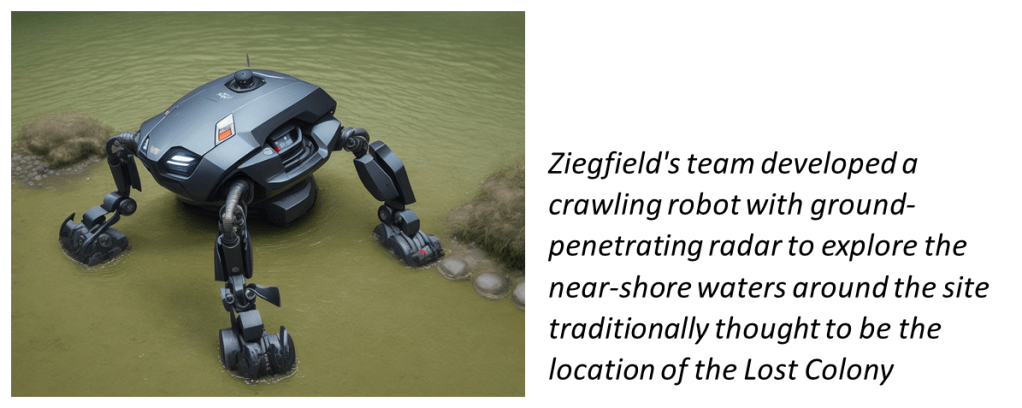
Ziegfield’s team used a specially developed ground-penetrating radar (GPR) to explore the near-shore waters around the site traditionally thought to be the location of the Lost Colony, extending their search to approximately 400 meters (1,300 feet) from the beach.
GPR typically is not effective for penetrating salt water, so Ziegfield and his crew developed a robot that looks like a large push lawnmower with crab legs. The robot crawled slowly along the bottom of the sound, setting itself down in direct contact with the floor of the sound to perform a scan before “standing up” and moving to the next area for examination.
The team also developed specific artificial intelligence algorithms to interpret the signals coming back from the robot crawler to detect anomalies hiding beneath the soils at the bottom of the sound.
Shocking Discovery
It took more than four months of scanning in the summer and fall of 2022 before Ziegfield’s group turned up what appeared to be a burial site at a depth of 8 meters (26 feet) below the surface of the water, under about 4 meters (13 feet) of earth. The site covered an area of about 100 square meters (1,076 square feet).
Once the team had established the location of 33 different suspected burial locations in the “dead zone,” as they called the burial area, they began careful excavation work to dig down to individual graves in search of remains. What they found shocked the team.
Ziegfield writes: “Upon excavating down to the first grave, we were stunned to discover a humanoid form bound and tightly wrapped in textiles that appeared to be consistent with materials manufactured in England in the late 16th century. Furthermore, upon bringing the remains to the surface for further examination, we discovered upon removing the fabrics from the individual that it was in fact a still functioning zombie, apparently a male, dressed in clothing that were, again, consistent with those that would have been worn by English colonists in the period of the Lost Colony.”
Only the fact that the colonial zombie was well bound saved the archeologists from being bitten and infected by the ancient undead, according to Ziegfield. The research team promptly pierced the skull and destroyed the brain of the unfortunate Englishman, sending him to meet his maker some 433 years after turning into one of the living dead.
In all, the team recovered 23 still functioning zombies that they believe were all interred around the same time, including nine adult males, eight adult females and six children split evenly between females and males.
The remaining ten suspected burial locations contained human skeletons wrapped in cloth and with evidence that the hands and feet had been bound. With these remains, the skulls showed signs of crushing post-burial, which would explain why this set of individuals rotted away to nothing but bones.
The team found no objects or artifacts buried along with the zombie colonists, but they were able to date the clothing and fabrics to the late sixteenth century through subsequent testing. In addition, genetic analysis of the virus found in the functioning undead revealed that it was of a strain prevalent in England at the time the Lost Colony was established.
The Meaning of “CRO”
Regarding the cryptic “CRO” carved into the tree at the site of the colony, Ziegfield sites a ship’s log entry from John White, the English explorer who helped establish the Lost Colony. White had left the colony in 1587 and returned to England for additional supplies, only to return three years later to discover the colonists missing.
In a log entry during the 1590 relief mission, White describes finding the abandoned settlement and, in a seemingly random note, writes “NECRO?” (“DEAD?” in Latin”) in the margins of the log. Ziegfield suggests that contemporaries of White conflated “NECRO” with the nearby Croatan Island and Croatan community of Native Americans, creating the narrative that the colonists had relocated to Croatan or gone to live with the Croatans.
But, Ziegfield believes, in fact, “NECRO” was a warning that the inhabitants of the Lost Colony left for anyone who followed them that the undead were afoot.
Given that the burial site discovered by Ziegfield’s team included at least 33 grave sites, what became of the other 80-90 colonists (including children born after the settlers arrived in the New World)?
Ziegfield declines to speculate, but he cites legends passed down among the indigenous communities native to the area around the Lost Colony. These legends speak of pale, soulless demons stalking the living and eating their flesh, although no concrete evidence has emerged of actual zombie attacks on the local Native American groups in the region.
“What we have discovered is not an answer to the mystery of the Lost Colony, but one more piece of a complex mosaic. We now know the fate of at least 33 of the colonists, but our search will continue to learn what became of the others. We owe it to these brave pioneers to finally put all their souls to rest,” Ziegfield concludes.
Like this kind of content? Subscribe to receive blog posts from the Bulletin of the Zombie Scientists in your Inbox or in the Reader app as they are published.
More Recent Posts
- Administration Weighs Deploying Undead to “Purify Woke Cities”
- President Fires Zombie Statistics Bureau Chief After Reported Rise in Undead Numbers
- Zombies of Different Generations Drawn to Different “Places of Meaning,” Study Finds
- “Z Visa” Program Would Let Wealthy Buy US Entry for Their Undead Relatives
- 6 Weeks after “Liberation Day,” Tariffs Still Loom for “Zombia”
Note: The Bulletin of the Zombie Scientists is a work of fiction. Any resemblance to persons (living, dead or living dead), actual organizations or actual events is entirely coincidental. See our About page and our Origin Story.
 Bulletin of the Zombie Scientists
Leave a comment