

By Bulletin Staff
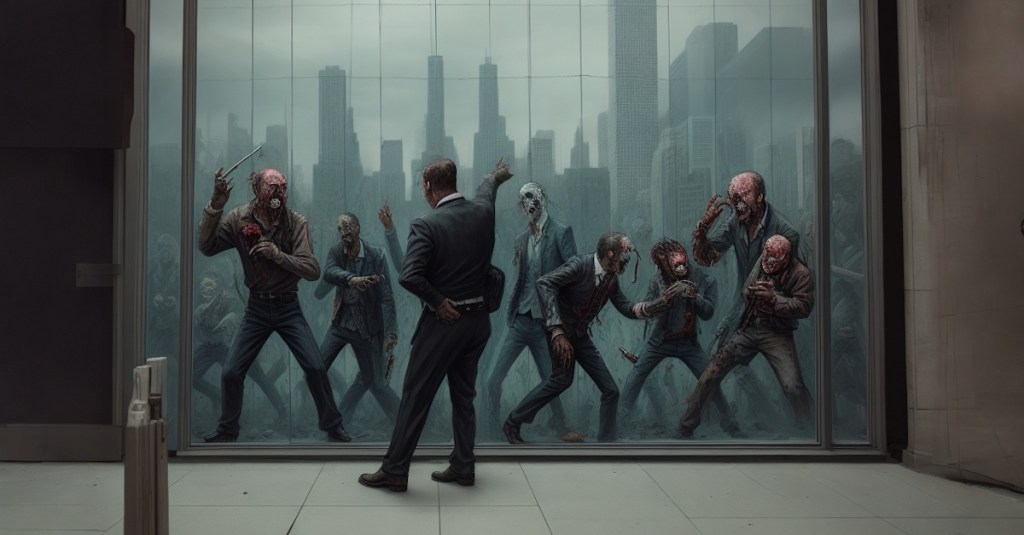
Over the course of a single night in early October, more than 200 zombies crushed their own skulls against a single Chicago building, causing a scene of devastation and gore in the streets of the Windy City.
The Chicago Health Department’s Zombie Response Team collected a total of 217 undead husks from the south side of the McKenna Convention Center building near the city’s downtown.
An analysis of the collected remains showed that the undead were all infected with the so-called “Rage” variant of the zombie virus made famous in the 2002 documentary “28 Days Later.” “Rage zombies” are known for their speed, agility and blind aggression.
In the Chicago incident, surveillance footage of the October 5 events made available by the Chicago Police Department shows that, over a period of less than five minutes, a steady stream of zombies charged headfirst into the south exterior glass of the McKenna Center, exploding their own brains against the glass panes.
The first living dead charged the building at 2:08 am, and the last splatted its rotting skull against the glass at 2:12 am, according to the surveillance video. No living humans were harmed in the incident, although several first responders were later treated for bruises and fractures from slipping on the oozing blood, brains and guts while clearing the husks.
“We were very lucky that only people that died during this horrific incident were already dead,” said Jenna Rogers, a CPD spokesperson. “If this had happened in the middle of the day, with the streets full of convention attendees, we’d be mopping up more than just zombie brains today.”
The next questions for authorities to address are where the undead came from and why they chose to crush their own skulls against the McKenna all at once.
Regarding the first question, police believe that the 200-plus zombies were part of a “Halloween rave gone bad” that had taken place the night of October 4-5 in an abandoned warehouse two blocks away from the McKenna.
Authorities point to what appear to have been live social posts from the rave showing a wave of rage zombie attacks sweeping through the attendees starting around 1 am, leaving no living humans alive in the warehouse within minutes.
Renata Torres, with the city’s Zombie Response Team, said that as the dead ravers exited the warehouse in search of uninfected humans to attack, they likely were drawn by the bright lights coming through the McKenna’s glass exterior.
“They seem to have just gotten all enraged together by the lights from inside the convention center and started charging into the glass, not realizing they were going to bash their own skulls in,” Torres said. “They had a block or two to accelerate, so by the time they crashed into the glass, they were all going like Usain Bolt speeds. Their heads just exploded on contact with the hardened glass.”
In a statement, the McKenna cited “unusual atmospheric conditions” on the night in question to explain why the undead might have been drawn to the convention center. The statement added that it was better for the zombies to have attacked the building rather than Chicagoans themselves.
Yolanda DeYoung, a professor of zombie science at the University of Chicago, said that incidents like this are rare but do occur periodically under similar circumstances. “When you get a large group of the living dead out in the streets at night looking for their next meal, it’s not surprising that they’re going to be drawn to the big shiny lights of a glass building,” DeYoung said.
The professor drew a parallel to the mass death of birds that, coincidentally, flew into the glass windows of Chicago’s McCormick Place Lakeside Center on the same night as the McKenna incident. “Birds, like zombies, are not always able to ‘see’ the glass between them and a light source, so they go flying into it and go splat,” said DeYoung.
In the bird incident, about 1,000 of the avians died after crashing into the McCormick Place building.
Torres, from the Zombie Response Team, said that her agency currently is still working to identify all the undead and also to clean and sterilize the site of the mass zombie deaths. “It’s hard enough cleaning up after one zombie, but here we’re talking about the brains of more than 200 of the living dead painted all over Chicago’s streets,” she said. “It’s still a real mess out there.”
Like this kind of content? Subscribe to receive blog posts from the Bulletin of the Zombie Scientists in your Inbox or in the Reader app as they are published.
More Recent Posts
- Administration Weighs Deploying Undead to “Purify Woke Cities”
- President Fires Zombie Statistics Bureau Chief After Reported Rise in Undead Numbers
- Zombies of Different Generations Drawn to Different “Places of Meaning,” Study Finds
- “Z Visa” Program Would Let Wealthy Buy US Entry for Their Undead Relatives
- 6 Weeks after “Liberation Day,” Tariffs Still Loom for “Zombia”
Note: The Bulletin of the Zombie Scientists is a work of fiction. Any resemblance to persons (living, dead or living dead), actual organizations or actual events is entirely coincidental. See our About page and our Origin Story.
 Bulletin of the Zombie Scientists
Leave a comment