
By Bulletin Staff
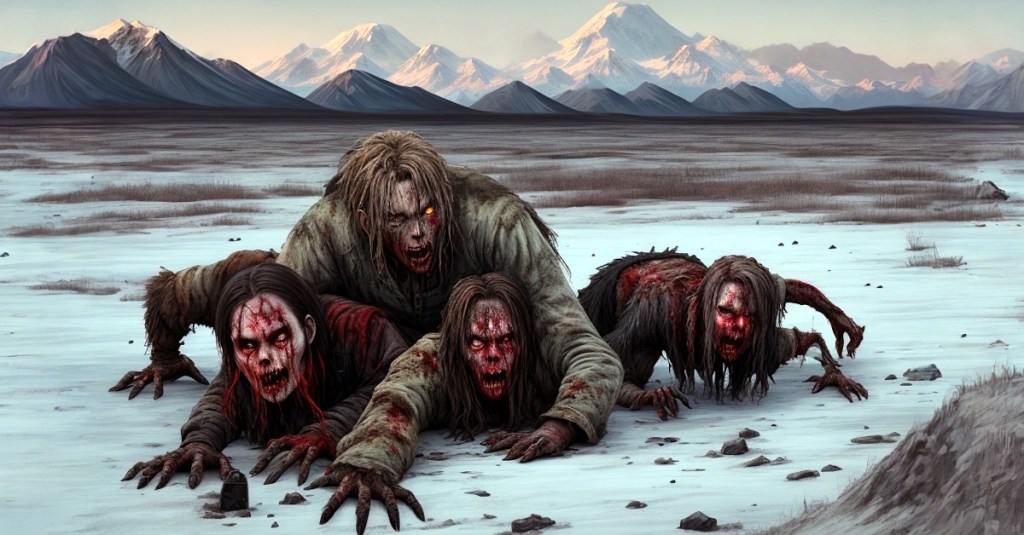
Increasing temperatures across Alaska are creating a number of challenges for the state, but perhaps none so urgent as the increasing number of zombies emerging from the melting permafrost.
Scientists estimate that tens of thousands of the undead could be encased in the frozen ground beneath Alaskan’s feet, and they warn that the state’s warming climate threatens to unleash waves of zombies upon residents of the Last Frontier.
“It’s really unnerving to think that thousands of unholy flesh-eaters could crawl out of the earth on any given warm summer day,” said Takaani Smith, a resident of Fairbanks. “It’s bad enough that no one up here has air conditioning, now we can’t even leave the windows open on a hot night for fear we’ll wake up as someone’s dinner.”
Defrosting of the Dead
Permafrost is ground that remains below freezing (0 degrees Celsius, 32 degrees Fahrenheit) year-round for at least two consecutive years. The frozen soil lies underfoot across about 85% of Alaskan territory, reaching as thick as 2,000 feet in the Arctic region. About 35% of the state has permafrost at or near the surface.
Alaska’s permafrost has been such a feature of daily life in the North for so long that significant infrastructure now lies atop the frozen earth, from roads and pipelines to homes and bridges. Alaska has literally been built on permafrost.
But as the planet has warmed steadily over the past decades, so too has the permafrost. The Arctic region has proved particularly vulnerable to climate change, warming three to four times faster than the rest of the planet. Estimates are that the permafrost on Alaska’s North Slope has warmed by as much as 4 degrees Celsius (7 degrees Fahrenheit) over the past century.
The result: Alaska’s permafrost is proving to not be so permanent. One study estimated that as much as a quarter of the near-surface permafrost in the state could vanish by 2100 due to climate change.
Road Damage, Floods … and Zombie Hordes
Melting permafrost has the potential to present a number of serious long-term challenges, not the least being the potential release of more than a trillion metric tons of the very carbon gas that is driving global warming.
In the immediate term, the melting permafrost causes erosion and flooding around the state and costs Alaska tens of millions of dollars in road and infrastructure repairs. Buildings have fallen into the sea, rail lines have been deformed, and a drive down the highway has turned into a rollercoaster ride.
But the most sinister aspect of the melting permafrost is what’s emerging from the once-frozen ground. In addition to anthrax, bubonic plague and other deadly viruses that have been frozen in the earth for millennia, Alaskan authorities now say that a growing number of zombies are rising out of the muddy soil, too.
A few recent incidents:
- Following a record-setting heatwave in June 2019, a dozen undead rampaged through Fairbanks, killing 37. An investigation found that the zombies had emerged from a melted patch of permafrost on the outskirts of the city. Analysis suggested that the dead had been frozen in place for more than 100 years prior to emerging from the slime.
- Officials of the Black Cat Mine, a zinc mine north of Kotzebue in the Northwest Arctic Borough, reported that five of their employees were devoured by a group of two dozen undead in July 2021. An investigation found that the zombies had crawled out of the once-frozen muck outside the mining camp, where they had been interred for at least 130 years.
- In June 2022, a herd of more than 30 living dead attacked oil workers in Prudhoe Bay, causing 29 deaths. Authorities traced the zombies back to a patch of defrosted permafrost near the workers’ camp, and they estimated that the undead had been encased in the frozen soil for at least 170 years.
- As July 2023 temperatures along Alaska’s northern coast soared 30 degrees above normal, law enforcement in Wainwright, a town of about 600 North Slope Borough, reported that a group of some 10 zombies wandered onto the runway of the town’s airport, where they were minced in the propellors of a bush plane that was taxiing for takeoff. Not enough of the zombies remained for an analysis to date them.
A Search for Perma-fixes
A 2021 research study conducted by the Division of Zombie Control under the Alaska Department of Public Safety estimated that as many as 50,000 zombies could emerge from the state’s unfrozen lands before then end of the century, presenting Alaskans with an unprecedented threat to life and limb.
In the wake of the study’s findings, the state established an Office of Undead Containment (OUC) under the Department of Transportation and Public Facilities (DOT&PF) in 2022 to study the zombie defrosting problem and propose solutions.
At a May 2023 forum organized by the Department of Zombie Studies at the University of Alaska Fairbanks, officials from the OUC outlined several proposed fixes, based largely on the DOT&PF’s experience building in permafrost. Proposed solutions included:
- Rip and Replace – Remove a layer of permafrost in zones around inhabited areas and replace it with rock and soil that has been confirmed to be undead-free.
- Deepen the Freeze – Install pipes called thermosiphons underground to lower the temperature of permafrost in winter to minimize summer melt and keep the dead frozen in place.
- Cover up the Problem – Lay a thick layer of rocks or a thin layer of concrete or asphalt – or both – over permafrost to entomb the undead below the surface even if the soil melts.
All these options are, of course, expensive and logistically difficult to implement over an area of any great size, let alone over 85% of the state. State officials believe that they could use a mix of these approaches to protect critical facilities, such as schools or hospitals, while also investing in hardening those sites against zombie attacks.
However, in the absence of fiscally feasible strategies for ameliorating the undead threat to Alaskans, it is likely that individual citizens in the state will need to continue to assume responsibility for protecting themselves from the defrosted dead. Considering that Alaska has one of the highest rates of firearms ownership among the US states, it appears that Alaskans are already preparing for the challenge.
Like this kind of content? Subscribe to receive blog posts from the Bulletin of the Zombie Scientists in your Inbox or in the Reader app as they are published.
More Recent Posts
- Administration Weighs Deploying Undead to “Purify Woke Cities”
- President Fires Zombie Statistics Bureau Chief After Reported Rise in Undead Numbers
- Zombies of Different Generations Drawn to Different “Places of Meaning,” Study Finds
- “Z Visa” Program Would Let Wealthy Buy US Entry for Their Undead Relatives
- 6 Weeks after “Liberation Day,” Tariffs Still Loom for “Zombia”
Note: The Bulletin of the Zombie Scientists is a work of fiction. Any resemblance to persons (living, dead or living dead), actual organizations or actual events is entirely coincidental. See our About page and our Origin Story.
 Bulletin of the Zombie Scientists
Leave a comment