
By Bulletin Staff
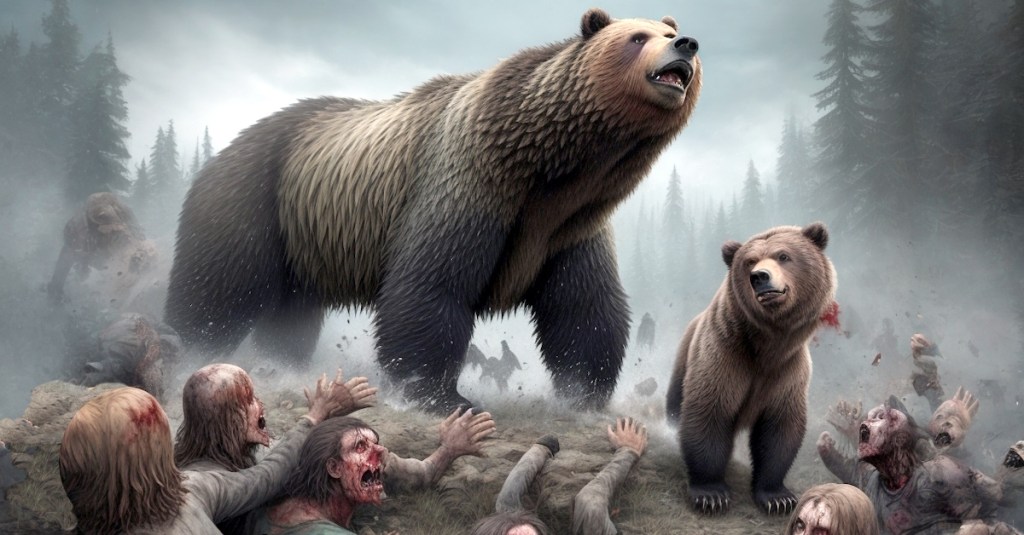
Zombie limbs, torn from their respective torsos, lay scattered around the forest glen like so many aspen branches shorn from their tree trunks. The torsos themselves were cast about the meadow, hunks of meat gleaming and rotting under the summer sun. Here and there, the head of one of the undead, torn from its body, worked its jaw, as if to apologize for its unkempt appearance.
“It was a godawful mess like nothing I’ve ever seen,” said Karel Kolchak, the forest ranger with Grand Teton National Park who led the cleanup of the July 2023 zombie massacre along a popular hiking trail in the park. “We couldn’t even put all the pieces back together to figure out how many zombies had been torn to bits.”
As it turns out, the trail is popular not only with hikers, but also zombies and bears.
“We found grizzly bear tracks, grizzly bear scat and grizzly bear-sized holes in some of the undead,” Kolchak said. “This was clearly the work of a grizzly. A very angry grizzly.”
Zombies in Bear Country
Hunting, tourism and poor conservation management drove grizzlies nearly to the point of disappearing entirely from the Yellowstone region that includes Grand Teton National Park (GTNP), which is in western Wyoming. By the 1970s, researchers estimate that only about 130 of the bears remained in the region.
Concerted conservation efforts, including educating the public to be “bear smart” when traversing the grizzly’s home turf, have helped the population rebound to between 800 and 1,100 today. Grizzly bear sightings and even encounters by hikers are not uncommon in the park nowadays, but grizzly attacks on humans continue to be rare despite the more than 2.5 million tourists that flock to GTNP each year.
Until recently, grizzly attacks on zombies in the park were also vanishingly rare, according to Gina Sparks, a government biologist who studies the zombie population in the nation’s national parks.
“It was really unheard of to have a grizzly maul one of the undead,” Sparks said. “The bears have an incredible sense of smell, and we would observe them making major detours to avoid a zombie herd or even individual zombies. They’d smell the putrefying flesh and head the other way.”
More Bears, More Zombies
That began to change in the late 2010s. The bear population in the Tetons was on the increase, and at the same time the number of the undead found in the park started to rise. Sparks attributes the growing population of zombies in GTNP to the influx of transplants into Wyoming’s neighbor to the north, Montana.
“The big cities in Montana’s Western Mountain region, like Missoula, Bozeman and Helena, have all seen significant growth as people moved in from California and other Western states. As the human populations of these cities grew, their zombie populations also grew, and since zombies tend to be drawn toward warmer climates, naturally the herds that formed in Western Montana began moving into the Tetons on their migration southward,” Sparks explained.
Notably, the first undead horde of more than 100 individuals in GTNP was spotted in late June 2017, moving south along the John D. Rockefeller Jr. Parkway around Lizard Creek. The herd attacked campers in a nearby campground, prompting the Park Service to deploy its Special Zombie Containment Unit to eliminate the undead.
That same year, 2017, also saw the first recorded grizzly attack on a group of zombies. Hikers tackling the Arizona Creek Trail in July captured the attack with cell phones, and the video quickly went viral after being posted to popular social sharing sites. The hikers shot the video from at least 200 yards away, but it clearly captures a large grizzly angrily shredding a small group of some dozen undead.
Zombie’s “Greatest Weakness”
Sparks participated in the investigation of the 2017 massacre and believes that the zombies came from downwind and surprised a mother grizzly and two cubs feeding on the carcass of an elk calf. When the living dead set upon the bears, the mother met the zombies with ursine fury, tearing them limb from rotting limb.
Zombies are particularly vulnerable to assault by large predators like a grizzly, Sparks said, because they lack any fear, will continue to advance toward to a predator despite clear signs of imminent attack, and follow none of the Park Service’s guidelines for how to respond in the event of bear attack (use bear spray if you have it, or stay still, lie flat on your stomach and cover your neck with your hands).
“A zombie’s greatest strength, its relentlessness, is its greatest weakness when it comes to responding to a bear encounter,” Sparks said. “Charging a bear that’s charging at you just isn’t smart. But then, nobody said the undead were that smart.”
No “Zombears” Yet
Since the 2017 slaughter, every summer season has seen at least one similar bear-on-zombies attack. In fact, the incidents have been on the increase: 1 each in 2018 and 2019, 2 in 2020, 3 in 2021, 4 in 2022, and 4 again (so far) in 2023.
“Grizzly violence against the undead is still rare, but it’s a growing problem that we continue to track closely,” the Park Service said in response to an inquiry about the extent of the problem. “We warn our visitors about encounters with bears and with zombies in the park, and we also warn them not to approach bears attacking zombies.”
Sparks believes that the grizzlies may be losing their fear of the undead over time. Much as the bears can become accustomed to human food by eating trash that careless campers leave in their wake, so too the grizzlies may also be acclimating to the smell, if not the taste, of zombie flesh.
“The bears don’t appear to be eating the zombies, just ripping them apart. Grizzlies have a broad diet, and they will eat decaying animals, but they don’t appear to be interested in decaying humans yet,” Sparks commented.
As for bears turning into undead after being biting, or being bitten by, a zombie, to date Sparks has seen no evidence that the grizzlies are susceptible to the zombie virus. “No, not yet,” she said, “we haven’t seen any zombears so far.”
Like this kind of content? Subscribe to receive blog posts from the Bulletin of the Zombie Scientists in your Inbox or in the Reader app as they are published.
More Recent Posts
- Administration Weighs Deploying Undead to “Purify Woke Cities”
- President Fires Zombie Statistics Bureau Chief After Reported Rise in Undead Numbers
- Zombies of Different Generations Drawn to Different “Places of Meaning,” Study Finds
- “Z Visa” Program Would Let Wealthy Buy US Entry for Their Undead Relatives
- 6 Weeks after “Liberation Day,” Tariffs Still Loom for “Zombia”
Note: The Bulletin of the Zombie Scientists is a work of fiction. Any resemblance to persons (living, dead or living dead), actual organizations or actual events is entirely coincidental. See our About page and our Origin Story.
 Bulletin of the Zombie Scientists
Leave a comment