
By Bulletin Staff
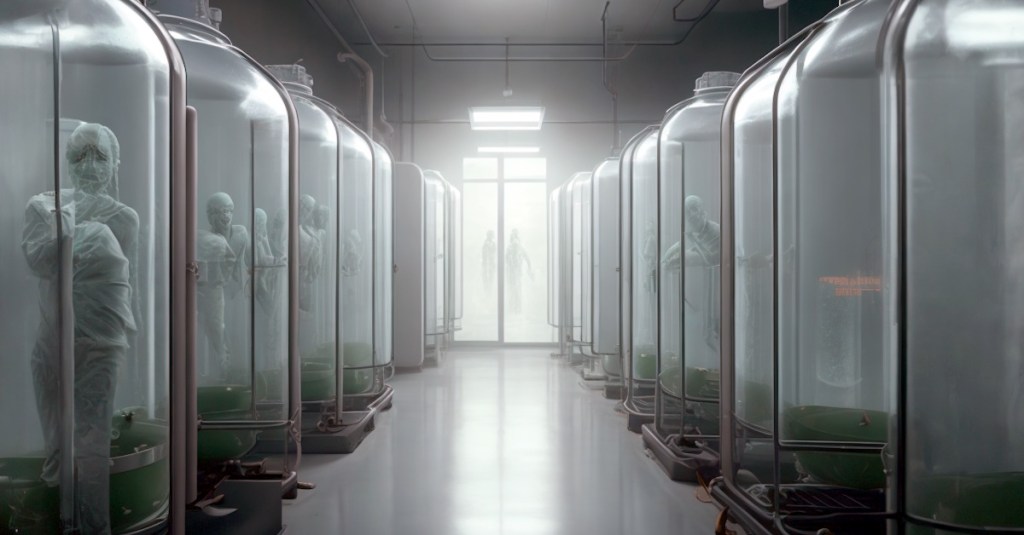
Inside an industrial building in Tempe, Arizona, a group of 37 undead is frozen in time, awaiting a cure that will reverse the zombification process and turn them into living humans again.
For a fee starting at $300,000, Cryomort Preservation, the company behind the subzero undead, pledges to keep a zombified loved one on ice until science comes up with a treatment for the zombie virus.
Leading a tour through the Tempe facility for a group of journalists, Dr. Robert Cauldron, Cryomort’s CEO, shows off neat rows of transparent tanks, each holding a cryogenically preserved member of the undead.
“This gentleman came to us from a family in the oil business,” Cauldron says, pointing to one of the tanks. “This woman came from a middle-class family that did a crowdfunding campaign to pay to put her on ice. We get all kinds of people, from every corner of society, who want to preserve their loved ones until they can be cured.”
A Tragedy Leads to Hope
After earning a medical degree and a PhD in zombie biology at Wexler University, Cauldron worked in the pharmaceutical industry for more than 20 years researching cures for the zombie virus.
He founded Cryomort in 2018, partly inspired by the work of another Arizona organization that has been cryogenically preserving human remains for more than 50 years. But the real impetus behind Cryomort was both personal and tragic.
“My twin brother Gallen was attacked by zombies while hiking in Sedona. We medevacked him to an intensive zombie care unit in Flagstaff, but there was really nothing that could be done. I felt so helpless watching the life go out of his eyes as the virus took control of him. I founded Cryomort because I didn’t want anyone else to go through that pain,” Cauldron explains.
Putting a Zombie on Ice
The cryogenic preservation process is more complicated for zombies than for a regular dead person, according to Emily Potts, chief medical officer for Cryomort. “First of all, a dead person will just lie on the table, but the undead will fight you every step of the process. There is always the risk of them biting one of our staff, even through all the PPE [personal protective equipment],” Potts says.
In broad terms, the process for a zombie requires replacing its bodily fluids with cryoprotectants that help to preserve the tissues and prevent further zombification or decay. The subject is then cooled to nearly 200 degrees below zero Celsius (-328 Fahrenheit), essentially solidifying the undead individual into a human-sized zombsicle.
Cryomort seals the preserved zombie into one of its purpose-built containment tanks and continues to monitor the undead, topping off the liquid nitrogen that keeps the unholy ice pop from thawing. Potts says that the zombie can be kept in that state in perpetuity, until science is able to reverse the zombification process.
“When we eventually get a cure for the virus, our staff would work with outside medical personnel to thaw out an individual, restore their natural bodily fluids, and then administer the treatment to bring them back from the undead,” Potts explains.
Only Fresh Zombies Accepted
How long after zombification can the cryopreservation process begin? Cauldron says that all their subjects have been put into the preservation process within 48 hours of turning, before the processes of decay and petrification have advanced too far.
“Usually a family will reach out to us before their loved one turns so that we can start preparing for transportation of the undead corpse to our facility. In some cases, they can be brought to us before they fully turn, which simplifies the process considerably because we don’t have to deal with all the red tape around interstate transportation of the undead,” says Cauldron.
Would Cryomort take a zombie that was already in advanced stages of rotting? No, says Potts, who explains that when an undead subject has already suffered significant internal decomposition, it’s not realistic to expect that the decay process could be reversed to give the undead life again.
That said, the company will accept zombies that have been significantly gnawed prior to zombification, in the belief that future medical science will be able to provide for any necessary fixes to limbs or major organs necessary to restore a member of the undead to full-fledged life again.
Cryomort also is looking at the possibility of preserving zombie brains on their own, with the idea that eventually science could reverse the zombification process in the brain tissue and then implant the brain into either a clone of the original individual or an android body capable of integrating with the brain.
Beware “Fly-by-Night” Zombie Freezers
Cryomort is currently the only facility in the US offering cryopreservation of zombies, thanks in part to several processes that the company has patented for specifically preserving the undead. The cryopreservation process itself has not been reviewed or approved by any governmental agency, but Cryomort has been licensed through federal and local authorities to handle the undead, and it has received an A+ rating from the group People for the Ethical Treatment of Zombies.
That’s significant, Cauldron says, because a number of shady “fly-by-night” operations offer to “freeze” the undead for fees ranging from $500 to $10,000. Often, once a family pays and hands over their zombified loved one, the fraudsters freeze the undead individual into a block of ice that’s kept in a cold storage warehouse under questionable conditions.
“The process of freezing the undead in ice usually destroys the brain tissue, so there’s no realistic hope of returning that individual from the dead as their original self. And then the storage conditions are far from ideal. In one case, a cold storage suffered a power outage and several of the freshly frozen undead thawed out and attacked staff and family members,” Cauldron says.
Would Cauldron go through the cryopreservation process if he were to become a zombie? Absolutely, he says.
“I hope never to become one of the living dead, but we live in a dangerous, unpredictable world. If I go zombie, the directives in my living will call for me to be delivered immediately to our facility to be preserved,” Cauldron says. “And then I can only hope that my ancestors will one day be able to rescue me from eternal damnation and return me to the ranks of the living.”
Like this kind of content? Subscribe to receive blog posts from the Bulletin of the Zombie Scientists in your Inbox or in the Reader app as they are published.
More Recent Posts
- Administration Weighs Deploying Undead to “Purify Woke Cities”
- President Fires Zombie Statistics Bureau Chief After Reported Rise in Undead Numbers
- Zombies of Different Generations Drawn to Different “Places of Meaning,” Study Finds
- “Z Visa” Program Would Let Wealthy Buy US Entry for Their Undead Relatives
- 6 Weeks after “Liberation Day,” Tariffs Still Loom for “Zombia”
Note: The Bulletin of the Zombie Scientists is a work of fiction. Any resemblance to persons (living, dead or living dead), actual organizations or actual events is entirely coincidental. See our About page and our Origin Story.
 Bulletin of the Zombie Scientists
Leave a comment