
By Bulletin Staff
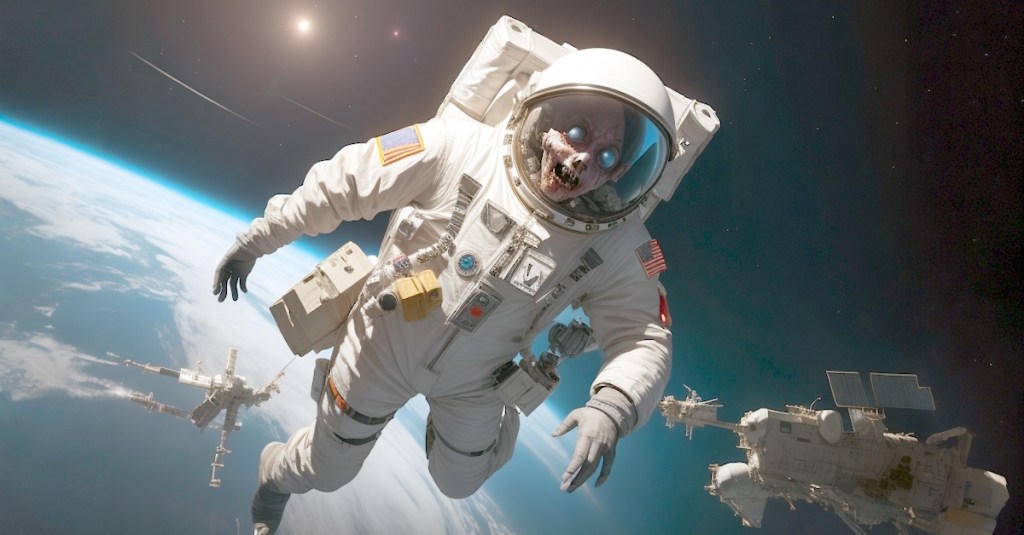
NASA has launched scores of men, women and other living creatures into space since Alan Shepard Jr.’s Freedom 7 mission in May 1961. But the space agency’s next mission will carry its first undead astronauts.
The cargo for next week’s blast off of NASA’s Space Launch System rocket includes five zombies that are being transported to the International Space Station (ISS) for a series of experiments to test undead biology and behavior in zero gravity and the vacuum of the cosmos.
It is, obviously, a risky mission, as NASA’s Director of Undead Missions, Robert Crinkle, acknowledged in speaking with the media this week.
“As with any space mission, any number of things could go wrong that create hazards for our crew. Whether it’s heat shield issues or the possibility of zombie escapes, NASA’s job is to anticipate all those possible risks and figure out how to prevent or mitigate them. We will keep our astronauts safe and among the living,” Crinkle said.
Scope Creep
It’s been 62 years since the Soviet Union launched Yuri Gagarin into space, marking humanity’s first venture into the vastness of the universe. Since then, more than 600 humans and countless animals have been sent into space.
But the idea of sending zombies into space only came about in 2017, when a group of graduate students in zombie science at Wexler University responded to a NASA call for research proposals with a unique proposition: Let’s send the undead to the ISS and see what happens.
The students’ initial proposal only called for testing zombie mobility in zero gravity. They proposed studying how the undead move and interact with humans and each other, and whether they float, crawl or find new methods of locomotion in the absence of gravity.
As the project advanced, the scope of the research expanded. Scientists from NASA and the European Space Agency (ESA) are now looking to investigate the rate at which zombies decompose in the cold and vacuum of space, studying the effects of extreme temperatures and cosmic radiation on their physical deterioration.
The researchers are also interested in whether the undead lose their appetite in a weightless environment, or do they continue to seek out their preferred foods of human flesh and brains. In addition, the science teams plan to track how long zombies can survive in a space environment without a steady supply of food.
Finally, the research brief for the mission calls for investigating the behavioral effects of space on zombies, confined as they will be to a small, enclosed space on the ISS, to determine whether they undergo changes in aggression or other behaviors.
Risky Cargo
The logistics of sending zombies to the ISS and then conducting experiments on them are, to put it mildly, complex. The undead won’t ride into the ether in the crew cabin but instead will be transported in an isolated cargo section, each zombie secured and sealed in its own containment unit – a coffin-like box with various monitoring equipment.
Once the NASA mission docks with the ISS, the crew will perform a spacewalk to move the zombie containment units into a specially prepared separate section of the station where the experiments will be conducted.
The undead lab is isolated via a secure hatch from the rest of the station, and in the event of an emergency or zombie escape, the crew can jettison the lab, which would then be directed toward Earth so that it would burn up as it reentered the atmosphere.
The mission’s crew includes two zombie scientists – one from the US, and one from France – who will conduct the experiments. In addition, a zombie liquidation specialist from the US Marines will accompany the flight and remain on the ISS for the duration of the mission in the event of any mishaps, escapes or transmission of the zombie virus to a crew member.
Controversy back on Planet Earth
The lab is configured to accommodate a total of ten zombie containment units, so the current complement of five undead could expand if the initial experiments prove fruitful and additional research projects get funded.
The research project has not been without controversy. In Washington, at a recent session of the House Subcommittee on Zombie Defenses, members from both parties raised concerns about funding what one representative called a “zombie field trip into space” while the nation continues to battle the undead here on planet Earth.
NASA officials responded by pointing out the breakthroughs in bioscience that have been achieved on the ISS, including advances in treatments for diseases ranging from cancer and genetic disorders to gum diseases. Valentina Tereshkova, NASA Director of Undead Science, testified that the agency believes similar discoveries are possible that could aid in humanity’s war against the living dead.
“Ray Bradbury wrote in The Martian Chronicles more than 70 years ago that ‘space travel is life-enhancing, and anything that’s life-enhancing is worth doing.’ These experiments with zombies have the potential to enhance our lives by helping us destroy the undead, and for that reason alone they are worth doing,” Tereshkova said.
Like this kind of content? Subscribe to receive blog posts from the Bulletin of the Zombie Scientists in your Inbox or in the Reader app as they are published.
More Recent Posts
- Administration Weighs Deploying Undead to “Purify Woke Cities”
- President Fires Zombie Statistics Bureau Chief After Reported Rise in Undead Numbers
- Zombies of Different Generations Drawn to Different “Places of Meaning,” Study Finds
- “Z Visa” Program Would Let Wealthy Buy US Entry for Their Undead Relatives
- 6 Weeks after “Liberation Day,” Tariffs Still Loom for “Zombia”
Note: The Bulletin of the Zombie Scientists is a work of fiction. Any resemblance to persons (living, dead or living dead), actual organizations or actual events is entirely coincidental. See our About page and our Origin Story.
 Bulletin of the Zombie Scientists
Leave a comment