
By Bulletin Staff
Every year millions of people are impacted by seasonal affective disorder (SAD), a form of depression more common in winter when the shorter days and colder weather limit exposure to sunlight. Thankfully, science has gained a better understanding of SAD in recent years, and therapeutic treatments for the disorder have brought relief to many who suffer from the affliction.
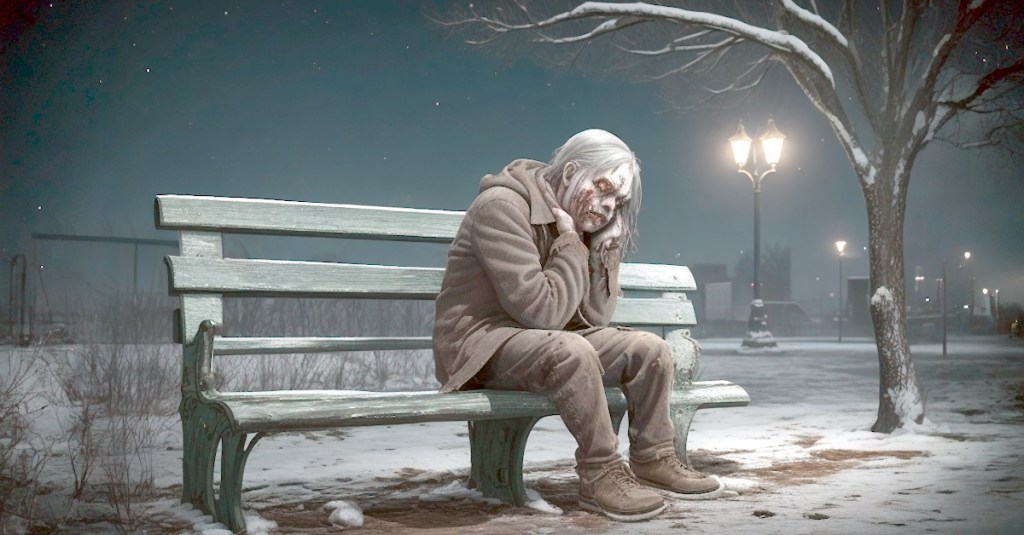
For zombie scientists, though, the question of how – or even whether – SAD impacts the undead has long remained unanswered. Now, however, a new research paper presented at the recent North American Conference of the Zombie Scientists sheds much needed light on this dark corner of zombie psychology.
What Makes a SAD Zombie?
In the paper, “The Chilling Effects of Seasonal Affective Disorder on Undead Behavior,” the authors note that, among living humans, symptoms of SAD can include low energy or listlessness, lack of focus or interest, excessive sleeping or weight gain, and even more serious symptoms of depression.
Zombies that appear to be affected by SAD share some similar symptoms, according to the paper, including a decrease in their activity levels. SAD zombies exhibit less of their usual aggressive behavior and are less reactive or slower to respond to external stimuli such as noise or movement, the researchers report.
The motor functions of SAD-impacted undead also seem to slow down during the seasons that trigger the disorder in them, making them move more sluggishly. This appears to be the case even in rage zombies that normally exhibit high levels of agility and speed of movement.
SAD seems to impact the appetite and feeding habits of the undead as well. Individual zombies were observed to be less motivated to pursue human prey or engage in attacks on living humans during the seasons that exacerbate their SAD.
Social withdrawal is another SAD symptom that the researchers said is typical of both the living and the undead. Among zombies, this withdrawal manifests as a tendency to wander alone rather than in herds, while the living may intentionally avoid social gatherings.
The shorter days and reduced exposure to bright sunlight appear to impact the living dead in a similar way as the living. Zombies showing signs of SAD seem drawn even more powerfully to sources of intense light than your average member of the living dead. (Experts in SAD in the living recommend exposure to a light source with a bright of at least 10,000 lux to help alleviate the symptoms.)
On the other hand, zombies do exhibit some symptoms of SAD that are specific to their state of non-living. For example, SAD-affected zombies were observed producing more subdued vocalizations: Instead of the typical guttural growls, they emit weaker moans, perhaps reflecting their reduced energy levels.
The paper’s authors also reported changes in the decay rate of undead impacted by SAD. The rate of biological decay in these zombies appeared to accelerate as their other symptoms of SAD became more pronounced, suggesting some kind of “mind-body” connection continues to exist even in the undead.
What Makes a Zombie SAD?
Interestingly, the scientists were unable to establish any direct connection between the occurrence of SAD in a living human and the likelihood of that person being affected by SAD after they had been zombified. The paper suggests that whatever causes SAD in zombies occurs as a result of post-mortem changes in the physiology or psychology of the living dead, and only about 1.0% of zombies appear to suffer from SAD, compared to 0.5% to 3.0% for the living.
That said, the researchers write that they cannot currently point to a single definitive explanation for the occurrence of SAD in the undead. Rather, they point to several potential causes, including the possibility that the zombification process causes a disruption in the levels of the hormones serotonin and melatonin, which have been linked to the disorder in the living.
The paper also speculates on the impact of changes in exposure to sunlight, theorizing that certain zombie virus strains may alter the biology of the undead in a way that makes their behavior more tied to the waxing and waning of daylight hours with the seasons.
Along the same lines, the scientists postulate that certain zombies could retain remnants of a circadian rhythm in their reanimated state, and the seasonal changes in the rising and setting of the sun could disrupt this rhythm, influencing their activity levels in the same way that daylight savings time can make the living sometimes “feel like a zombie” as they adjust to time changes.
Finally, the researchers suggest that the undead might have a dietary need for certain types of flesh or human-sourced nutrients that are only available in abundance during specific seasons. A lack of access to these resources during other times of the year could lead to a decline in their physical capabilities, according to the authors.
How to Tell If Zombies Are SAD?
To study SAD in the undead, the scientists conducted long-term observations of zombie behavior throughout different seasons by following both known herds and individual living dead to understand their movements, activity levels and interactions in various environments.
In the lab, the researchers created controlled environments mimicking different seasons and observed how their zombie subjects reacted to changes. For instance, they exposed the undead to varying light conditions, temperatures and weather patterns to assess the impact on their behavior.
Some neurobiological assessments were conducted where it was possible to secure access to the brains of still functional zombies to identify any changes associated with SAD, such as seasonal variations in neurotransmitter levels.
In the article, the authors acknowledged the dangers of conducting these kinds of research projects involving studies of functional zombies, and they dedicate the article to two of their colleagues, Drs. Carla Bonhoff and Geordi Yanov, who were attacked and devoured while observing a herd in South Dakota as part of the project.
The lead author on the paper was Dr. Valerie Negroni with the Center for Undead Studies. Co-authors included Prof. Mortimer Decator, zombie neurobiologist with the Department of Zombie Physiology at Wexler University; Dr. Luna Nightshade, behavioral ecologist at the Institute for Zombie Ecology; and Dr. Victor Zimbowitz, virologist with the Institute for Contagious Outbreaks and Zombie Virus Research.
Bran Wintershadow, a seasonal dynamics specialist with the Center for Seasonal Anomalies, and Dr. Cassandra Grimm, a survivor interaction analyst at the Institute for Human-Zombie Interaction, also contributed to the research.
If you or someone you know is in crisis, call, text or chat with the Suicide and Crisis Lifeline at 988, available 27/7/365. You are not alone.
Like this kind of content? Subscribe to receive blog posts from the Bulletin of the Zombie Scientists in your Inbox or in the Reader app as they are published.
More Recent Posts
- Administration Weighs Deploying Undead to “Purify Woke Cities”
- President Fires Zombie Statistics Bureau Chief After Reported Rise in Undead Numbers
- Zombies of Different Generations Drawn to Different “Places of Meaning,” Study Finds
- “Z Visa” Program Would Let Wealthy Buy US Entry for Their Undead Relatives
- 6 Weeks after “Liberation Day,” Tariffs Still Loom for “Zombia”
Note: The Bulletin of the Zombie Scientists is a work of fiction. Any resemblance to persons (living, dead or living dead), actual organizations or actual events is entirely coincidental. See our About page and our Origin Story.
 Bulletin of the Zombie Scientists
Leave a comment