
By Bulletin Staff
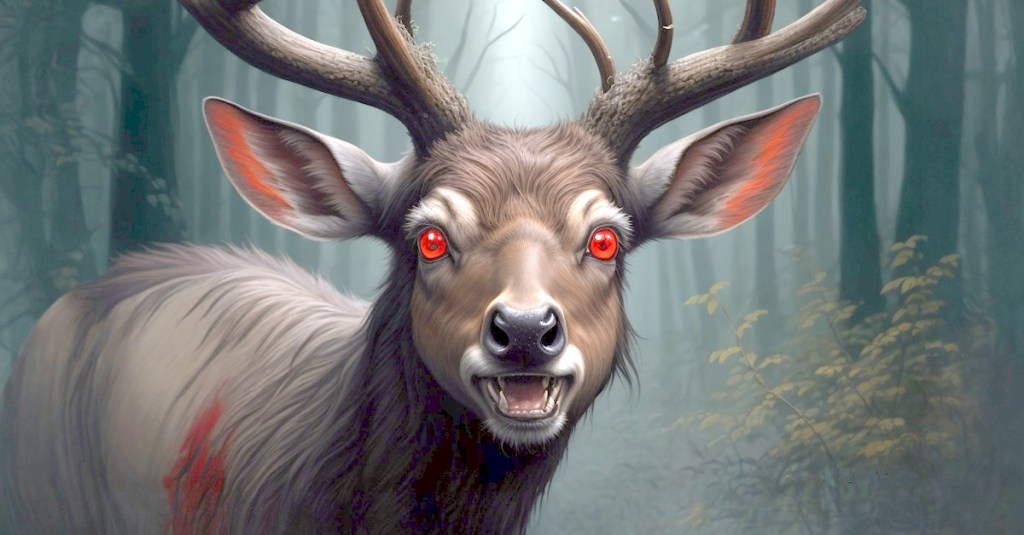
The US Park Service this week put to rest rumors of a zombie on the loose in Yellowstone National Park when it announced that a mule deer buck infected by “zombie deer disease” had been found near Yellowstone Lake in the southeastern section of the park.
No human zombies were reported in Yellowstone, according to government sources that requested anonymity because they were not authorized to speak publicly about zombie-related matters.
This was the first confirmed positive detection of chronic wasting disease (CWD), also known as “zombie deer disease,” in Yellowstone, according to the Park Service’s statement on the discovery.
The disease affects cervids like deer, elk and moose and is fatal, with no known vaccine or treatment. Caused by a malformed protein (or “prion”) rather than a traditional zombie virus, CWD causes affected animals to exhibit certain classic signs of zombification, including listlessness, extreme weight loss, excessive drooling and a lack of fear of people, leading to the nickname “zombie deer disease.”
Other symptoms include head lowering and increased urination and drinking, which have not been widely documented in human victims of the zombie virus. Typically, human zombies are not known to urinate, and they only drink blood incidentally during the consumption of their victims.
Animals contract CWD from other infected creatures either through direct contact or by coming into contact with the infection through feces, soil or vegetation.
According to the Centers for Disease Control, no cases of CWD infection have been reported in people, and neither have any cases of human zombies turning up carrying the prion that causes chronic wasting disease.
That said, the CDC warns that some studies have suggested that certain non-human primates, such as monkeys, could be at risk of contracting the disease if they eat the meat of animals infected with CWD or otherwise come in contact with bodily fluids or brain tissue from infected animals.
“These studies raise concerns that there may also be a risk to people. Since 1997, the World Health Organization has recommended that it is important to keep the agents of all known prion diseases from entering the human food chain,” the CDC advises.
In other words, don’t eat zombies, whether of the deer, elk, moose or, for that matter, human variety.
The prions that cause CWD and similar diseases, such as bovine spongiform encephalopathy (“mad cow disease”) or the human disease Creutzfeldt-Jacob disease (“human mad cow disease”), are remarkably difficult to eliminate (see the article “Prions Are Forever” in Scientific American).
However, what the prions are not is an actual zombie virus. “CWD causes some zombie-like symptoms, but it doesn’t cause a deer to start attacking and devouring other, uninfected deer,” said Gina Sparks, a government biologist who studies the zombie population in the nation’s national parks.
Sparks nevertheless cautioned that more research must be done into possible connections between diseases like CWD and classic zombie viruses. “It would be good to understand whether being infected with a prion-based disease makes animals – or humans – more susceptible to zombification. On the other hand, perhaps there is some property of the prions that offers a ‘cure’ for the zombie virus.”
She also called for increased funding for the study of zombies in the national parks, noting, “The Yellowstone zombie was just a deer this time. Next time we might not be so lucky.”
A few additional key differences between CWD and the zombie virus to note:
- While zombie deer disease first showed up in the US in captive deer in the 1960s (and in wild deer in the 1990s), the human zombie virus has been known to exist since the dawn of humanity (or before).
- The government has documented CWD in at least 29 states, and the disease has also been reported in countries as diverse as South Korea, Finland and Canada. Zombie virus cases have been reported in every corner of the planet.
- The CDC estimates that as much as 10% of the wild deer population may be infected with CWD, whereas estimates of the human population affected by the zombie virus range from 1-3% for areas not experiencing outbreaks to 50-100% for outbreak zones.
- The economic impact of CWD has not been widely studied, although the US Geological Survey has pegged the cost of managing the disease at around $25 million annually (based on 2020 figures). The CDC’s National Center for Zombie Diseases has estimated the economic cost of the zombie virus to be at least $57 billion annually in the US (2021 figures).
Additional resources on CWD:
- Zombie Deer Disease: Everything To Know About Chronic Wasting Disease After Yellowstone Confirms First Infection (Forbes)
- National Park Service information on CWD
- CDC article on CWD in animals
More Recent Posts
- Administration Weighs Deploying Undead to “Purify Woke Cities”
- President Fires Zombie Statistics Bureau Chief After Reported Rise in Undead Numbers
- Zombies of Different Generations Drawn to Different “Places of Meaning,” Study Finds
- “Z Visa” Program Would Let Wealthy Buy US Entry for Their Undead Relatives
- 6 Weeks after “Liberation Day,” Tariffs Still Loom for “Zombia”
Note: The Bulletin of the Zombie Scientists is a work of fiction. Any resemblance to persons (living, dead or living dead), actual organizations or actual events is entirely coincidental. See our About page and our Origin Story.
 Bulletin of the Zombie Scientists
Leave a comment