
By Bulletin Staff
The Pilgrims of the village of Plymouth on Massachusetts Bay had much to be thankful for in the fall of 1621.
They had survived the treacherous 66-day ocean crossing from Plymouth, England, on the Mayflower to make landfall in the New World. They had survived their first harsh winter, which saw half their number perish from disease and the harsh conditions.
And they had established friendly relations with helpful Native Americans who imparted the knowledge and skills necessary to survive in New England, from how to raise corn and catch fish to which local plants were edible and which were poisonous.
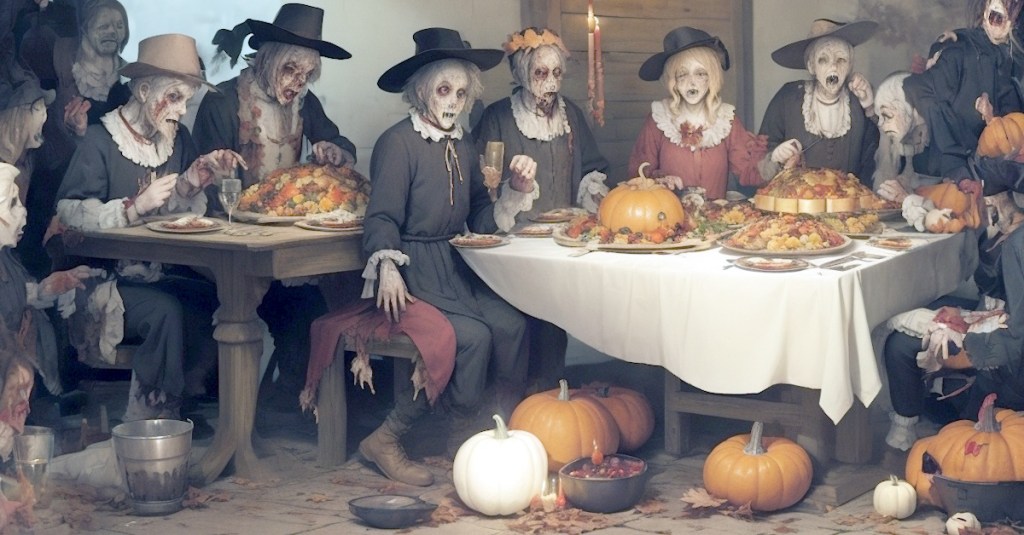
Yet the Pilgrims who gathered to celebrate the harvest of 1621 and give thanks for their many blessings were perhaps most grateful that they had survived their first zombie outbreak in their new homeland.
Nearly Forgotten Zombie History
The story of the Pilgrims’ brush with the living dead was long forgotten by history. Following the incident, the Pilgrims themselves buried the tale along with the corpses of the undead who had threatened to destroy their settlement.
The Pilgrims feared that if word got out about the outbreak, they would be shunned by the local Native American tribes whose friendship they so depended on for their survival. And the highly devout Pilgrims also perceived the appearance of zombies in their midst as a sign of evil, a stain to be washed away and never spoken of again lest the demonic spirits return.
It was only with the discovery of the journal of Miles Brewster more than 400 years after the first Thanksgiving that historians came to learn of the Plymouth outbreak. Brewster was a pipe-maker, a man of little wealth but sufficient education to be literate, and a devoted chronicler of the Pilgrims’ early years at Plymouth.
His journals, dating from the start of the Pilgrims’ voyage to the New World until Brewster’s death in 1624, were discovered in 2022 among a cache of family papers passed down through more than 20 generations of Brewsters. Historians have authenticated the journal and are now reexamining the early years of the Plymouth settlement in light of Brewster’s writings.
What follows are excerpts from Brewster’s journal that shed light on the Plymouth outbreak, describing the terror that gripped the Pilgrims in the fall of 1621 as they prepared for their second winter in the New World and their first Thanksgiving feast. [Language has been edited and updated for clarity.]
From the Journal of Miles Brewster
October 30, 1621
The air is crisp with the promise of winter, yet our hearts are warmed by the spirit of gratitude that fills our humble settlement. After months of toil and hardship, we find ourselves on the cusp of a day unlike any other – a day where we shall gather, give thanks and break bread in unity. The fields surrounding our settlement have yielded a generous harvest, and the bounty of the land promises a feast that shall mark our resilience in this New World.
However, a shadow looms over our anticipated festivity. A curious affliction has befallen one of our own, sending ripples of concern through our close-knit community. There is hushed talk of a mysterious sickness, and a foreboding lingers like smoke from our fires. Though our hearths burn bright and our tables are adorned with the fruits of our labor, a sense of unease settles among us.
It is a forewarning, a silent harbinger of unforeseen peril that casts a sobering pall over our eagerly awaited gathering. Yet, as we prepare for this feast of thanks, our resolve remains unshaken. We brace ourselves against the unknown, hoping that our unity and faith will serve as our shield in the face of uncertainty.
November 3, 1621
Dark tidings have befallen our blessed settlement. What began as murmurs of concern has burgeoned into a haunting reality. The tranquility of our life in Plymouth has shattered as we discovered that a fellow Pilgrim, once vibrant and full of the Lord’s spirit, has fallen prey to an affliction that defies reason. Feverish whispers speak of a bite and an infection that spreads quickly and darkens the flesh and the soul.
Fear has woven its tendrils among us as we confront the chilling prospect of an adversary we cannot see and barely comprehend. Our hearts are heavy with sorrow and trepidation as we grapple with the ramifications of this ominous occurrence. Questions abound in whispered tones. How does one combat a threat so foreign, a menace that strikes at the very core of our fragile existence in this New Land?
The urgent hushed conversations echo within our makeshift halls, carrying urgent pleas for vigilance and caution. Our once tranquil haven is now fraught with tension, the specter of an unseen enemy looming ominously over our planned celebration. In this moment of uncertainty, unity becomes our beacon, rallying us to stand steadfast against the encroaching darkness.
November 5, 1621
Our settlement is besieged by an unseen adversary, a foe that lurks within our very midst. The afflicted Pilgrim, once a cherished member of our close-knit community, now rests under vigilant care, isolated in the hope of stemming the ominous tide. Our efforts are tireless as we scramble to organize, devising strategies to protect our cherished settlement. Barricades are erected, precautions taken, and a tense yet determined energy permeates the air as we brace ourselves for the unknown.
Each member of our settlement shoulders a weighty responsibility, standing as a bulwark against the encroaching darkness. The clatter of hastily fashioned defenses mingles with the murmurs of prayers uttered in earnest supplication. We stand united in our faith, resolved to shield our humble abode from the chilling grasp of this unforeseen peril. Our resolve stands unyielding, a testament to the strength woven within our collective spirit in the face of adversity.
November 6, 1621
The solemn vigil we maintained over our fallen comrade shattered in an instant as a dreadful and unholy transformation unfolded before our unbelieving eyes. The once familiar face of our afflicted kin contorted into something unrecognizable. The metamorphosis was swift, driven by an insidious force that robbed our companion of his former humanity.
The transformed figure, bereft of reason or familiarity, lunged forth with an otherworldly hunger and set upon our fellow settlers. Panic seized our hearts as the ghastly reality of the situation unfolded, sending shockwaves through our once tranquil settlement, straining the bonds between family and friends.
We began a desperate struggle for survival against this unhallowed threat. At first we attempted to restrain our former companion, but he fought strongly against us, even biting several of us. It was only when Master Brown [thought to be Robert Brown, a fellow Pilgrim] struck the raving soul forcibly about the head several times with an oaken cudgel did our companion finally lay at rest as his corpse gave up its fluids and brains to the earth.
November 7, 1621
Against the backdrop of looming uncertainty and threat of further attacks by the dreadful unholies, our feast of giving thanks unfolds, shrouded in a tapestry of tension. The aroma of roasted game and freshly harvested produce mingles with the palpable anxiety that hangs heavy in the air.
As we partake in this feast, vigilance becomes our silent companion, a watchful guardian amidst the joviality. The laughter that once resonated freely now carries an undertone of restraint, our joy tempered by the looming specter of danger as we closely watch those who had been bitten by our fallen companion, and who now themselves show signs of the same ghastly affliction.
Each morsel savored carries with it a bittersweet tang, a reminder of the fragility of our existence in this uncharted territory. We give thanks to the Lord for his bounty and pray that he lifts the veil of infection from our comrades before they too turn upon us with anger and gnashing teeth.
November 8, 1621 – Entry 1
The horror of our predicament escalated as the inexplicable affliction that had befallen one of our own began to spread its malevolent grasp among our tightly knit community. The once serene atmosphere turned turbulent, haunted by the chilling realization that the enigmatic contagion had not been contained. The infected, akin to harbingers of a grim fate, exhibited the same haunting transformation that had robbed our comrade of humanity.
The dreadful sight of fellow Pilgrims succumbing to this inexplicable affliction plunged us into an abyss of despair and frantic desperation. Each new case, each fallen comrade turned ravenous, served as a grim reminder of the precariousness of our existence in this uncharted land. Fear and sorrow gripped our hearts. Yet we were united in our determination and our faith that our Lord would provide us with the strength, courage and oaken cudgels needed to overcome this evil misfortune.
And verily did Master Prower [thought to be Robert Prower, a fellow Pilgrim and renowned maker of weaponry] ensure that all our surviving numbers had at hand a strong staff of the hardest wood with which to bludgeon our bestricken comrades firmly about the head to put an end to their suffering and to our own jeopardy.
November 8, 1621 – Entry 2
As the embers of our feast of giving thanks wane and the flickering hearth casts a glow upon our weary faces, reflections upon this day of juxtaposed triumph and tribulation weigh heavily upon our hearts. The echoes of our collective resilience resound within these makeshift walls, a testament to the unyielding spirit that binds us together in times of adversity, as well as to the divine power that the Lord has seen fit to provide to us so that we might defeat this profane menace.
We have weathered the storm of the evil dead, our resolve unbroken despite the lurking shadows that sought to diminish our celebration. Amidst the uncertainties and palpable fear that gripped our hearts, we found strength in each other – a strength that served as our guiding light through the darkest of hours and that allowed us to brain the hellish creatures unleashed upon us.
November 9, 1621
As the sun sets on the final day of our feast and on this unprecedented chapter in our settlement’s history, introspection takes hold, weaving the lessons learned into the fabric of our collective consciousness. The events that unfolded during our gathering, which we shall evermore call our Thanksgiving Feast, shadowed by the specter of the unknown, have left an indelible imprint upon our hearts and minds.
Foremost among the lessons gleaned from this ordeal is that unity stands as our most formidable shield against the encroaching darkness. Our resilience, forged amidst the trials and tribulations, serves as a beacon guiding us through the uncharted waters of this New World. And we shall carry on with our renewed faith in the protection of our Lord as well as the protection of strong oaken cudgels.
Moreover, this harrowing experience has ignited a deeper sense of empathy within our souls. It has taught us to look beyond the veil of the unfamiliar, to seek understanding even amidst the most unsettling circumstances. In the face of uncertainty, our capacity for compassion and empathy has proven to be a powerful force, bridging the chasm between the known and the unknown, between fear and understanding, between the sanctity of our faith and the dark netherworld of the evil dead.
More Recent Posts
- Administration Weighs Deploying Undead to “Purify Woke Cities”
- President Fires Zombie Statistics Bureau Chief After Reported Rise in Undead Numbers
- Zombies of Different Generations Drawn to Different “Places of Meaning,” Study Finds
- “Z Visa” Program Would Let Wealthy Buy US Entry for Their Undead Relatives
- 6 Weeks after “Liberation Day,” Tariffs Still Loom for “Zombia”
Note: The Bulletin of the Zombie Scientists is a work of fiction. Any resemblance to persons (living, dead or living dead), actual organizations or actual events is entirely coincidental. See our About page and our Origin Story.
 Bulletin of the Zombie Scientists
Leave a comment