
By Bulletin Staff
When the Japanese Navy attacked the US Naval base at Pearl Harbor, Hawaii, shortly before 8 am local time on December 7, 1941, their primary objectives included hobbling the US Pacific Fleet by destroying or crippling key assets like the battleships moored at the port.
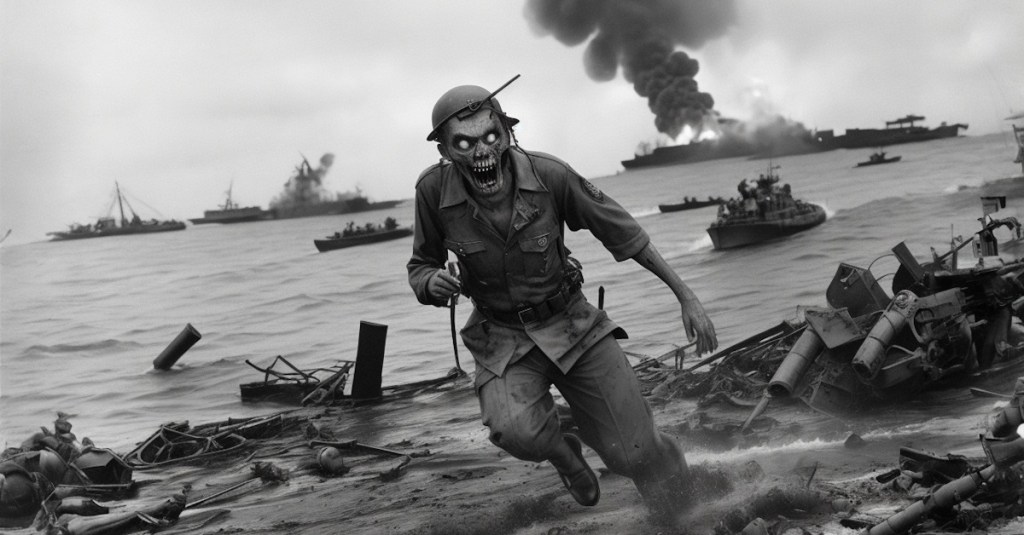
But recently discovered documents reveal that the Japanese also were aiming to destroy another key US asset housed at the base: the US military’s secret zombie warfare facility, known as the Undead Warfare Development Project (UWDP).
The Zombie Program at Pearl Harbor
The US military had set up its zombie warfare research program in the 1920s, but the project largely tread water until the late 1930s as tensions rose both in Europe and the Pacific. UWDP’s mission was simple: Figure out how to employ zombies on the field of battle in a way that gave the US a strategic advantage over its adversaries.
The military’s Office of Undead Operations established the UWDP facility at Pearl Harbor scarcely 12 months before the Japanese attack, with the express goal of researching options to use zombies in offensive operations in the Pacific Theater against a presumed Japanese opponent.
Hawaii offered terrain typical of many of the battlefronts that the US military expected to be contesting in a possible war with Japan. For example, the UWDP experimented with airdropping groups of the undead into the jungle to see how well the zombies could navigate the dense foliage they could expect to encounter in real-life battle scenarios in the Pacific.
Another trial involved launching the undead from submarines in torpedo-like craft that would land on a beach and open to unleash the zombies on coastal defenders in advance of an invasion force (a tactic that actually was used, with some success, in the Normandy invasion later in WWII).
To support the UWDP’s work, the project team maintained a secret holding facility for the undead participants in its experiments at the Ford Island Naval Air Station in Pearl Harbor. The facility housed around 200 zombies at the peak of the program.
Japan Targets American Zombies
Documents recently discovered in the archives of Japan’s military show that Japanese intelligence learned of the UWDP program shortly after the agency set up shop on Ford Island. As Japan’s military leadership planned its surprise assault on Pearl Harbor, the zombie facility became a key target.
Rear Admiral Ryūnosuke Kusaka, who led the planning effort under Admiral Isoroku Yamamoto, was particularly keen to destroy the UWDP site. At the time, Japan’s own efforts to weaponize the undead were still at very early stages of development, and Kusaka was concerned that failing to eliminate their adversary’s zombie assets would leave Japan vulnerable to attack by the living dead forces of the US.
However, the recently discovered archival material suggest that Japan’s intelligence service wildly overestimated US undead capabilities, believing that America had hordes of zombies in reserve that they were prepared to unleash upon Japan at the start of a conflict.
It also appears that the Japanese spy agency provided Kusaka and Yamamoto with exaggerated estimates of the impact of an attack on the UWDP site at Pearl Harbor. They predicted that thousands of the undead would be released to attack US Navy personnel at the base and civilians around the base.
In fact, the facility was holding only about 100 zombies at the time of the December 7 attack and, moreover, Ford Island, being an island, was isolated from the civilian population in Honolulu. At best, any escaping hordes of undead might have complicated operations at the air base on the island for a time, or the zombies might have wandered into the bay and created a navigation hazard for naval craft.
The Attack Unfolds
Be that as it may, as the attack unfolded on the morning of December 7, a squadron of Japanese Val dive bombers armed with 550-pound bombs in the first attack wave was tasked with specifically targeting the UWDP facility.
In follow-up to the Vals’ attack on the facility, a squadron of Zero fighters was tasked with strafing any US military personnel seen to be working to contain the expected mass flight of zombies from the UWDP holding pens.
The Vals, in fact, did destroy the UWDP facility. To that extent, their mission was a success. But the bombing also destroyed most of the undead program participants held in the facility, too. In all, the US Navy subsequently estimated that no more than 15 zombies actually escaped the holding pens, and most of those were destroyed by “friendly fire” from the strafing Zero fighters.
That said, a handful of zombies did manage to make their way onto the island’s airfield and cause a degree of chaos among the US forces scrambling to respond to the Japanese attack. The Navy reported that at least eight of its personnel were bitten and turned by the unleashed undead before the outbreak could be quashed by the base’s Special Undead Containment Unit.
Aftermath of the Attack
The Japanese attack on Pearl Harbor lasted scarcely 90 minutes, and historians have documented that it failed to accomplish several key objectives, ranging from destruction of US aircraft carriers (which were not in the harbor at the time of the attack) to unleashing an undead horror on Honolulu.
Nevertheless, the attack resulted in more than 2,300 casualties among American servicepeople, as well as dozens of US civilian casualties. Among the major losses was the battleship USS Arizona, which saw its forward magazine explode, killing nearly 1,200 mostly junior enlisted personnel. Civilian casualties of the attack included nine firefighters from the Honolulu Fire Department (HFD) firefighters.
Following the attack, US President Franklin D. Roosevelt delivered his famous address to a joint session of Congress, calling December 7 “a date which will live in infamy” and calling for a declaration of war on Japan, which Congress quickly delivered.
Unmentioned in Roosevelt’s speech or in American media coverage of the attack was the destruction of the zombie facility on Pearl Harbor, which was considered top secret at the time. The existence of the UWDP and the broader US zombie weaponization program during WWII was only revealed in the 1990s as a result of a broader declassification initiative.
Following the attack and Roosevelt’s speech, Yamamoto reportedly wrote in his journal, “I fear all we have done is to awaken a sleeping giant and fill him with a terrible resolve.” Indeed, the American giant would quickly arise and bring all its military might – including its undead forces – to bear in the battle to defeat the Axis powers and deliver victory in WWII.
Like this kind of content? Subscribe to receive blog posts from the Bulletin of the Zombie Scientists in your Inbox or in the Reader app as they are published.
More Recent Posts
- Administration Weighs Deploying Undead to “Purify Woke Cities”
- President Fires Zombie Statistics Bureau Chief After Reported Rise in Undead Numbers
- Zombies of Different Generations Drawn to Different “Places of Meaning,” Study Finds
- “Z Visa” Program Would Let Wealthy Buy US Entry for Their Undead Relatives
- 6 Weeks after “Liberation Day,” Tariffs Still Loom for “Zombia”
Note: The Bulletin of the Zombie Scientists is a work of fiction. Any resemblance to persons (living, dead or living dead), actual organizations or actual events is entirely coincidental. See our About page and our Origin Story.
 Bulletin of the Zombie Scientists
Leave a comment