
By Bulletin Staff
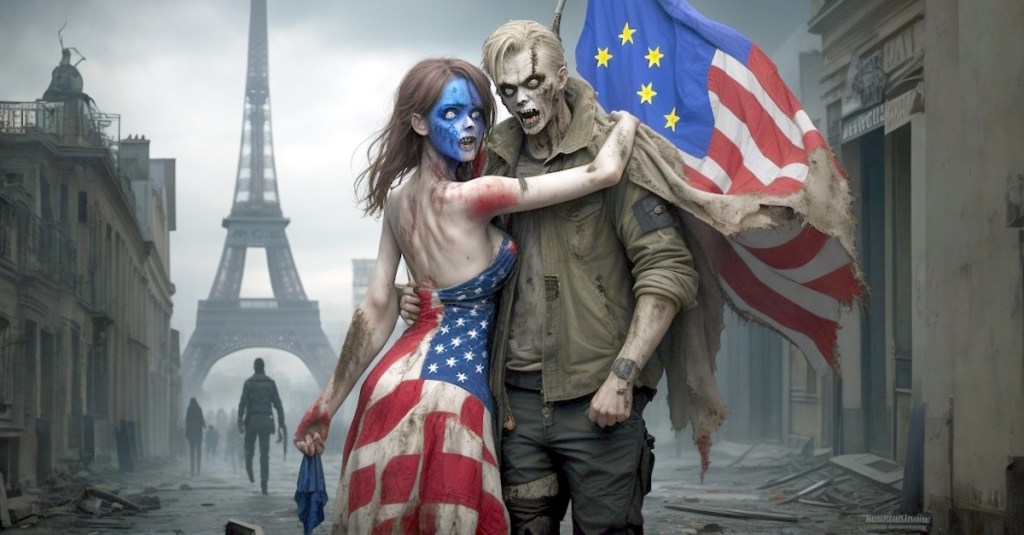
The European Union Parliament this week is nearing passage of an ambitious, comprehensive law to regulate zombies and the fight against the undead. Meanwhile, in the US, talks between Republicans and Democrats in Congress to pass a similar law remain stalled.
The EU has often led the US in efforts to pass large regulatory laws, and the EU Undead Act is no different. Experts in European law expect that the EU Parliament will hammer out a deal that all its member states can sign onto by the end of the year.
Congressional sources, on the other hand, say that it could be years before the US adopts a comprehensive law regulating the undead.
The competing timetable between the EU and the US is not the only difference in how the two legislatures are approaching the question of how to control the zombie population, fight the undead hordes and minimize risks from the living dead.
In a nutshell, the EU’s tendency toward centralized oversight and comprehensive regulation contrasts with the US’s decentralized, sectoral and community-driven approach in dealing with the undead. Both strategies aim to mitigate the zombie threat while balancing public safety and individual freedoms, albeit through fundamentally distinct regulatory philosophies.
The EU’s Approach to Zombie Regulation
The European Union has taken a risk-focused strategy to tackling the menace posed by the living dead, based on a set of principles laid out at the beginning of the proposed EU Undead Act.
The first principle is risk-based containment. The EU law would categorize zombies based on threat levels and their potential to cause harm. Differentiating between slow-moving versus fast and aggressive zombies, for example, the law calls for implementing stricter containment measures for high-risk zombie categories, focusing on quarantine protocols, fortified safe zones and the use of armed forces when necessary.
Secondly, the EU law proposes a prohibition on hazardous behaviors, banning actions that could exacerbate the zombie threat. This would include bans on behaviors such as deliberately attracting zombies, creating new zombies through reckless actions or withholding vital information about zombie outbreaks. In essence, the law would place a higher priority on collective security versus absolute individual liberty.
The Undead Act also emphasizes transparency and joint preparedness. For example, the EU prioritizes transparency in disseminating information about zombie outbreaks, promoting public awareness and preparedness. They mandate clear communication channels and provide for establishing programs to educate citizens about zombie behavior and survival tactics.
Finally, the European Union would establish centralized oversight of issues related to the undead. The EU would establish a centralized, pan-union agency responsible for monitoring zombie activity, enforcing regulations and coordinating cross-border efforts to combat the undead. In the EU’s way of thinking, this kind of centralized authority can better ensure coordinated responses and compliance with zombie containment measures.
The US Approach to Zombie Regulation
In contrast to the EU, the US Congress’ approach to regulating zombies reflects an emphasis on decentralized and sector-specific regulations.
As in other areas of regulations where it has taken a sectoral approach, the US has been focused on developing tailored response plans for different regions and industries. For example, separate proposals in Congress have zeroed in on measures specific to urban centers, rural areas, healthcare facilities and transportation hubs to address the unique challenges posed by zombies for each of these different areas.
The US approach has also involved a focus on encouraging community-led initiatives, guided by a common set of ethical principles, to deal with the undead. In a zombie outbreak scenario, for instance, this might involve supporting voluntary community defense groups bound by ethical codes and guidelines to ensure the humane treatment of infected individuals.
The situation in the US is also more complex because different states have already been moving to adopt their own strategies for managing zombie outbreaks. This typically leads to a diverse array of approaches and responses across the nation.
Supporters of this “laboratory of democracy” approach argue that it offers a better chance of coming up with solutions that match the circumstances in specific locales and that it affords states the opportunity to learn from each other’s successes and failures.
In this view, the federal government should focus on doing what the national government alone can do (or can do best), including funding basic research on zombie defenses and undead behavior, and using agency-led task forces to coordinate federal, state and local efforts in containing the undead threat.
Experts Weigh the Pros and Cons
Professor Maria Lopez, an EU regulatory compliance expert with the firm ZomBTrack, says she generally supports the EU’s approach to zombie regulation, asserting that the Europeans’ strategy ensures a unified and structured response to the undead.
“By categorizing zombie threats and establishing centralized oversight, the law would prioritize communal safety while upholding ethical principles. Our approach minimizes chaos across the entirety of the EU space,” Lopez said.
However, Dr. Thomas Bennett, a renowned scholar of EU law based in Brussels, offers a critical perspective on the union’s approach. “While the EU’s intentions are noble, their centralized approach is likely to be impractical in the face of a widespread outbreak. Rapid response and adaptability are key in such crises, and a top-down regulatory system can hinder timely local action.”
Bennet argues that flexibility and decentralized decision-making are vital for survival in a constantly evolving zombie landscape. “The EU’s rigidity risks overlooking the necessity for agile, localized strategies to combat the undead threat effectively,” he said.
Dr. Sarah Johnson, an emergency response specialist who consults with state governments on zombie outbreak preparedness, agrees with Bennett that decentralized strategies empower local communities and industries to tailor responses to the unique challenges that they might face when dealing with a localized outbreak.
“This flexibility allows for swift adaptation and innovation in combating the undead. By fostering community-driven initiatives and sector-specific plans, we ensure a diverse yet united front against the zombie threat. Ultimately, this is going to foster both resilience and resourcefulness in the face of the ravenous undead,” Johnson said.
But Professor David Garcia, a policy analyst and governance expert in the area of undead regulations with the Washington-based thinktank DeadThink, expressed concerns about the US approach, highlighting that the decentralized nature of US zombie regulation will inevitably lead to fragmented and inconsistent responses.
“Community involvement is commendable, but the lack of a unified, centralized oversight mechanism can lead to inefficiencies, contradictory measures and uneven protection for citizens in different communities. In a crisis as dire as a zombie outbreak, a more coordinated, standardized approach is crucial to mitigate risks and ensure a cohesive national defense against the undead,” Garcia concluded.
Like this kind of content? Subscribe to receive blog posts from the Bulletin of the Zombie Scientists in your Inbox or in the Reader app as they are published.
More Recent Posts
- Administration Weighs Deploying Undead to “Purify Woke Cities”
- President Fires Zombie Statistics Bureau Chief After Reported Rise in Undead Numbers
- Zombies of Different Generations Drawn to Different “Places of Meaning,” Study Finds
- “Z Visa” Program Would Let Wealthy Buy US Entry for Their Undead Relatives
- 6 Weeks after “Liberation Day,” Tariffs Still Loom for “Zombia”
Note: The Bulletin of the Zombie Scientists is a work of fiction. Any resemblance to persons (living, dead or living dead), actual organizations or actual events is entirely coincidental. See our About page and our Origin Story.
 Bulletin of the Zombie Scientists
Leave a comment