
By Bulletin Staff
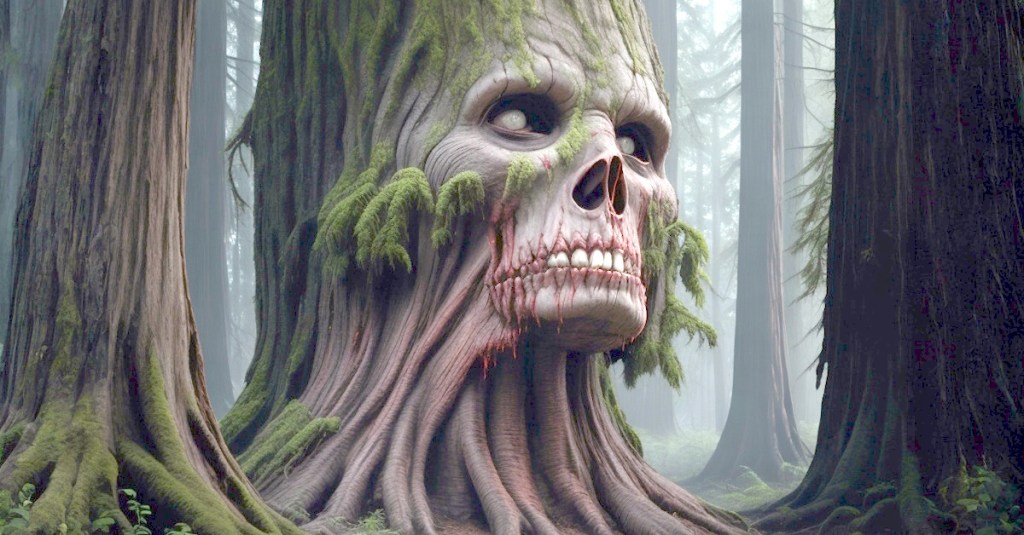
In perhaps the strangest ever example of the phenomenon of edaphoecotropism, scientists have discovered what they believe to be a 1,500-year-old zombie embedded in a giant sequoia tree in Yosemite National Park in California.
Edaphoecotropism is the process by which trees and other plants incorporate foreign objects into themselves as they grow. As trees add to their living tissue, they sometimes take the path of least resistance when they encounter an object in their way and simply grow around it, even if that object is a bicycle or automobile.
Dendrologists studying the giant sequoias, or Sierra redwood trees, in a remote section of Yosemite have been taking core samples of the skyscraping trees to understand their growth cycles and their adaptation to changes in the climate.
Dendrochronologists extract the core samples and study variations in the tree rings that allow them to identify periods of drier or wetter climate conditions. Typically a sample contains layer upon layer of hardened cells of alternating lighter and darker hues that delineate the passing seasons.
What the samples typically do not contain is human zombie tissue. But that is exactly what turned up in a sample from a giant sequoia in a remote corner of Yosemite in early September of this year, according to Parker Frank, who leads the dendrology team working on the project.
“We were looking at our latest samples back in the lab, and one of our researchers came across an odd ‘gap’ made up of strange tissues separating the rings in one of the cores,” explained Frank, who teaches at Morino College in nearby Stockton, California. “It definitely wasn’t plant material, so we sent it to a biolab at the college for analysis. When we got the results, needless to say we were all stunned.”
The lab analysis showed that the unknown tissues came from one of the living dead. But how could the zombie tissues have gotten into the core sample of a tree that was estimated to be nearly 1,700 years old? One clue: The zombie that the tissues came from appeared to be as old as 1,500 years, based on the state of the sample.
“It was Occam’s razor,” Frank said. “There really was only one explanation: One of the living dead was embedded deep in the tree.”
With permission from the Park Service, Frank’s team returned to the tree and cut away a section of the wood to within a couple feet of the zombie buried within the mighty redwood. Then they began the painstaking process of carefully peeling away layers of wood roughly in the area where the undead tissues were thought to have come from within the tree.
Since the undead that supplied the tissues appeared to still be functional, despite its age, Frank’s crew took Level 5 precautions, carrying out the laborious work in full hazardous zombie materials suits that provide protection from bites and bodily fluids from the undead.
“The work was excruciating, and it wasn’t helping that it was really warm this fall. We were all just dying in the ‘zombimat suits,’ so we had to work in short shifts, grinding, filing and stripping away the tree matter,” Frank said.
By mid-October, after weeks of chipping away at the wood, the team discovered a patch of what appeared to be zombie flesh overlaid with a fine layer of translucent cellulose. Using that patch as their new starting point, the scientists gradually peeled away additional wood in the same area until one full cellulose-covered finger revealed itself.
Then came another finger. Then a hand and an arm and a shoulder and so on until the tree revealed the full outline of the embedded zombie. Immobile, the zombie could only move its eyes, tracking movement and light through its cellulose shroud. Other than the hole created when the research team had pierced the undead while taking the core sample, the zombie appeared undamaged.
The cellulose held the undead in place and at the same time apparently preserved the zombie’s tissues and prevented it from rotting away. It’s a phenomenon that Frank and his team still don’t understand. “It’s like the tree and the zombie had merged in some symbiotic way,” Frank said. “It was freaky – and horrifying.”
Based on the depth of the undead within the tree’s ring structure, the dendrochronologists on the team estimate that the zombie is probably about 1,500 years old, making it one of the oldest functional zombies ever discovered.
The scientists believe, based on the position of the zombie, that it became trapped somehow against a portion of the tree’s trunk that had the bark shorn or burned off, possibly due to some catastrophic weather event.
Unable to move and deprived of a source of living flesh or brains, the zombie remained at rest against the tree over a period of centuries even as the redwood’s continued growth enveloped it and eventually fully embedded it with the tree’s tissues.
Given the age of the zombie, scientists believe that it may have been a member of the Ahwahnechee, a Native American people who have lived in the Yosemite Valley for perhaps as long as 7,000 years. Beginning in the 1850s and continuing into the late 1960s, the US federal government essentially drove the Ahwahnechee and other Yosemite Native peoples from the lands that now comprise the park.
Frank said that his team has been in touch with representatives of the local Native community in Yosemite Valley to discuss how to properly treat and dispose of the undead, which remains immobile and encased in cellulose at the tree site.
The science team has not disclosed the location of the giant sequoia in question to protect both the remains of the undead and the general public.
Frank said that his team is still working to assess how the tree and zombie interacted biologically over the course of the centuries. “We want to understand whether there was any DNA passed between the undead and the redwood. Did the zombie become part of the tree? Did it essentially become a plant?”
Asked whether the opposite could also be true, that the tree might have become part of the zombie – or “part zombie” – Frank said the team is exploring that possibility, too. “It’s a chilling thought,” he said, “that we could have a 300-foot killer zombie redwood tree growing in the heart of Yosemite.”
Additional dendrochronology-related reading:
- A sliver of wood from a 200-year-old tree has a dire warning for Earth: Hidden in the trunk of an ancient ponderosa pine in Arizona is a warning for the planet (The Washington Post)
Like this kind of content? Subscribe to receive blog posts from the Bulletin of the Zombie Scientists in your Inbox or in the Reader app as they are published.
More Recent Posts
- Administration Weighs Deploying Undead to “Purify Woke Cities”
- President Fires Zombie Statistics Bureau Chief After Reported Rise in Undead Numbers
- Zombies of Different Generations Drawn to Different “Places of Meaning,” Study Finds
- “Z Visa” Program Would Let Wealthy Buy US Entry for Their Undead Relatives
- 6 Weeks after “Liberation Day,” Tariffs Still Loom for “Zombia”
Note: The Bulletin of the Zombie Scientists is a work of fiction. Any resemblance to persons (living, dead or living dead), actual organizations or actual events is entirely coincidental. See our About page and our Origin Story.
 Bulletin of the Zombie Scientists
Leave a comment