
By Bulletin Staff
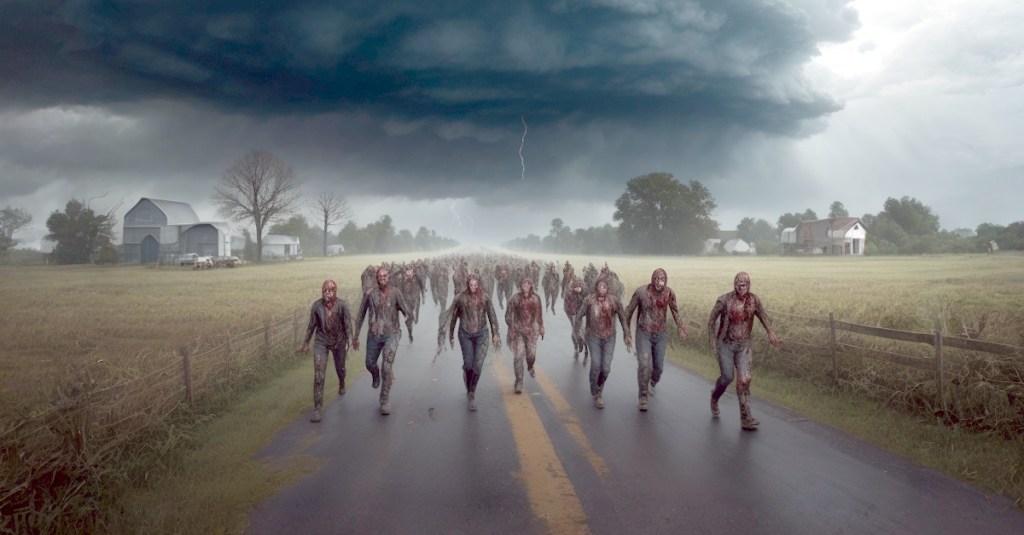
To mark the anniversary of the Great Zombnado that hit Bluefield, Iowa, 65 years ago this week, the Bulletin spoke with several survivors of what has been called “the worst zombie-related weather catastrophe to hit the Midwest.” Part I of this multipart series follows below.
Bill Jenson remembers the afternoon of January 12, 1959, like it was yesterday. “It had been pretty warm for January in Iowa, but on the twelfth it got up past 50. It was a hint of spring before winter gripped us again,” says Jenson.
Jenson, 87, has spent his entire life on the family farm outside Bluefield, Iowa, just north of what is now US Highway 80, halfway between Des Moines and Omaha City. In the afternoon of January 12, 1959, he was taking advantage of the unusually warm weather to work on one of the farm’s tractors when he heard the first warning come over the transistor radio.
“The Weather Service is now predicting possible tornadoes in Central Iowa this afternoon. Residents are advised to keep an eye on the weather and prepare to take shelter in the event of severe storms in their area.”
No stranger to the destructive potential of twisters, Jenson paused his work to alert his family back at the farmhouse to the coming storms. But before he could crawl out from under the tractor, Jenson heard the second warning.
“A zombie herd has been spotted in northeastern Cass County,” the announcer intoned, referring to county just west of Bluefield. “The herd is believed to be headed east. Authorities advise residents to be on the alert and prepare to take shelter if approached by the herd.”
“We were used to tornado warnings, but my heart skipped a beat when I heard the undead alert come over the radio,” Jenson says now, “because I knew that we might get hit by the only thing worse than a tornado: a zombnado.”
– – –
In Bluefield, around this same time, Deputy Hal “Spike” Arnold was just beginning his shift for the town’s small police force, heading out onto the quiet streets of the bucolic burg in his department-issued Ford Fordor cruiser.
“My day was just getting started at 1 pm when I got a call from dispatch to check out a report of a herd of undead west of town, across the county line” recalls Arnold, now 88 and long since retired from the force. Like Jenson, Arnold remembers the events of January 12 clearly despite the passage of time.
“I pulled over and got the Remington 870 [shotgun] and extra ammunition out of the trunk of the Ford, checked that my Colt [revolver] was loaded, and then headed out on US 6 [later to become US 80] to see if I could find this so-called ‘herd.’ Big zombie hordes were pretty uncommon in these parts at the time, but we’d all had some experience with the undead, and we all knew what the protocol was,” Arnold says.
“Our standing orders,” he explains, “were to observe from a distance, radio for reinforcements from the state troopers or the Feds, and intervene only when human life was imminently at risk. We were all highly aware of the Tuscaloosa incident from 1956, and no one wanted a repeat of that disaster.”
Bluefield is scant miles from Cass County, and Arnold, heading west out of town, crossed the county line – in his words – “doing 90 per,” pushing the Ford’s straight-6 engine to its limit.
Just a few miles past the county line, at the intersection of US 6 and State Route 148, Arnold spotted two Cass County Sheriff’s Department patrol cars parked off the road and pulled over to confer with the deputies.
The deputies related that the initial call on the zombie herd had come in from a state highway patrolman who spotted the herd around Crooked Creek, a few miles further west. The herd of maybe 300 undead was trudging east following US 6, moving slowly but steadily in the direction of Bluefield. The patrolmen was following discretely at a safe distance in his patrol car, periodically calling in updates.
The lawmen were alert, but not alarmed, Arnold says. At the zombie’s slow pace, it would be another hour, at least, before they reached 148, assuming they held course. “We figured as slow as the zekes move, we had plenty of time to coordinate a response before the herd reached town,” Arnold relates.
But then Arnold heard the squawk of his patrol car radio, and the dispatcher relayed the Weather Service’s warning about bad weather and possible tornadoes heading for Bluefield. Arnold immediately passed on the warning to his fellow lawmen and began surveying the horizon to the west.
Sure enough, the sky was darkening quickly, taking on the brownish-yellow hue that was a sure sign of a potential twister to come. Arnold’s heart sank. “When I heard about the tornado and then saw the storm line developing out west,” he recalls, “my first thought was, ‘Good Lord, we got us a potential zombnado.’ And then my second thought was, ‘This could get bad.’”
– – –
Back in Bluefield, Morris Zantz was working the register at his family’s general store on Main Street. Zantz’s great-grandfather, Alfred, had founded the Bluefield store at the turn of the century, and generations of Zantzes had turned it into a town institution.
Just 17 in January 1959, Morris Zantz had worked in the store since before he could walk. “After I was born, my father would bring me to the store and carry me around while he stocked the shelves. I learned to count by inventorying cans of beans,” he laughs.
On January 12 of that fateful year, Zantz headed to the store after his last class at Bluefield High and took over for his sister, Ellie, on register. Customers came and went, Zantz greeting each one by name, bagging their groceries and making change. He barely glanced through the store’s big front glass window and didn’t notice the skies darkening overhead with the approaching storm clouds.
“It was a busy afternoon, and the last thing I was thinking about was tornadoes or zombies,” says Zantz, now 82. “Little did I know that we’d get both that day.”
Around 3 o’clock, his father came out of the store’s backroom and told him to turn on the radio that sat on a shelf behind the register. “That spooked me,” Zantz says, “because the store rule was that the radio remained off except when there was an emergency. So right away I was concerned.”
The announcer at the local radio station was in the middle of reading a Weather Service alert when Zantz turned on the radio, but Zantz didn’t need to hear the full report to understand what was happening. Even at 17, he had lived through enough tornado seasons to know that something bad was heading toward Bluefield.
“I said to my father, ‘Sounds like we could get a tornado. Should we close the store?’ But then he shushes me and points to the radio, and the next thing they’re saying is that a zombie herd is headed toward town, too. I looked at my father, and he said just one word: ‘Zombnado.’”
Next in Part II: The zombnado touches down in Bluefield, threatening to leave the town a wasteland of destruction and undead.
Like this kind of content? Subscribe to receive blog posts from the Bulletin of the Zombie Scientists in your Inbox or in the Reader app as they are published.
More Recent Posts
- Administration Weighs Deploying Undead to “Purify Woke Cities”
- President Fires Zombie Statistics Bureau Chief After Reported Rise in Undead Numbers
- Zombies of Different Generations Drawn to Different “Places of Meaning,” Study Finds
- “Z Visa” Program Would Let Wealthy Buy US Entry for Their Undead Relatives
- 6 Weeks after “Liberation Day,” Tariffs Still Loom for “Zombia”
Note: The Bulletin of the Zombie Scientists is a work of fiction. Any resemblance to persons (living, dead or living dead), actual organizations or actual events is entirely coincidental. See our About page and our Origin Story.
 Bulletin of the Zombie Scientists
Leave a comment