
By Bulletin Staff
To mark the anniversary of the Great Zombnado of 1959 that devastated Bluefield, Iowa, the Bulletin of the Zombie Scientists spoke with several survivors of what has been called “the worst zombie-related weather catastrophe to hit the Midwest.” Catch up with Part I of this multipart series here, and read Part II below.
Late in the afternoon on January 12, 1959, Deputy Hal “Spike” Arnold with the Bluefield Police Department found himself parked alongside US 6 watching a slow-moving herd of zombies and a fast-moving storm system, both bearing down on his hometown.
“You live around here long enough and you get a feel for when a tornado is coming and how bad it’s going to be. The way the clouds move, the color of the sky, the smell in the air. That day, it smelled bad,” says Arnold, now 88.
“And then there were the undead,” the deputy adds. From a distance, Arnold could see the funnel clouds trying to form as the looming storm swept in behind the shambling zombie herd. By now, the dead had moved to within a mile-and-a-half of where Arnold and a pair of sheriff’s deputies were pulled off the highway.
A highway patrolman had first spotted the zombie herd when it was still further west of Bluefield. The patrolman had put the call out for reinforcements from his Iowa State Patrol colleagues, and Arnold could already see the flashing red lights of as many as 40 patrol cars converging on their location. Help was on the way.
Arnold heard his patrol car radio squawk again as his dispatcher called for an update, and the deputy climbed back into the sedan to report on the progress of the herd and the storm system. “We didn’t have any smartphones or weather apps back then,” Arnold reminds us. “So the folks back in town were blind to what was happening out in the fields.”
As Arnold filed his report, the wind picked up sharply outside his patrol car, rising to a roar like a freight train rushing past at full throttle. Then, over the howl of the wind, the deputy heard shouting and warning cries from his fellow law officers standing watch by the highway. “Hold on,” Arnold told his dispatcher. “Something’s happening.”
When Arnold stepped back out of his patrol car, a sharp gust immediately knocked him backwards and all but blinded him. Leaning into the wind and shielding his face, he caught sight of the other officers as they dove into the ditch along the other side of the two-lane blacktop.
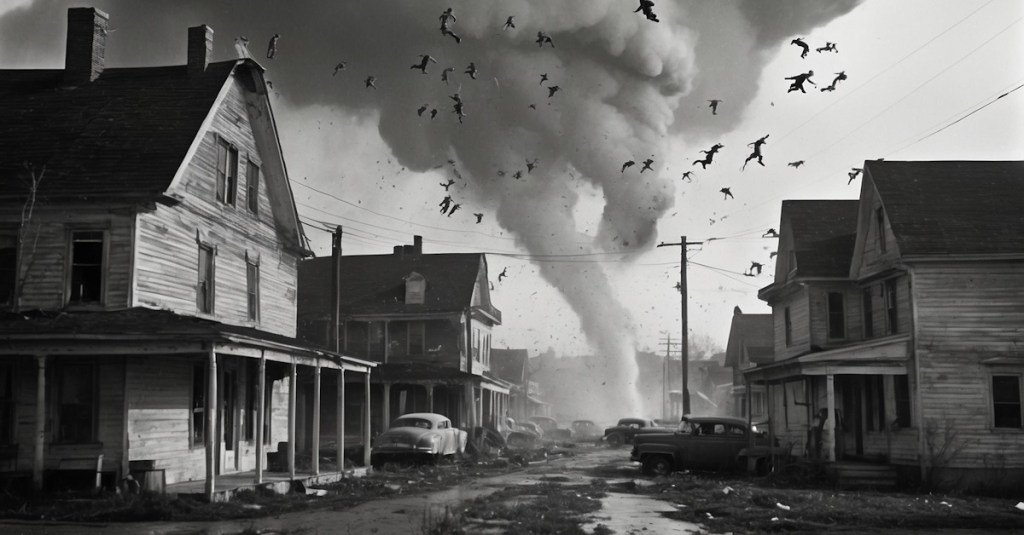
Turning his gaze westward, into the wind, Arnold saw a fully formed funnel cloud, perhaps a half-mile wide, scooping up the entirety of the zombie herd and sending the undead into a swirling whirlwind of rotting limbs and gnashing teeth.
“Aw, nuts,” Arnold remembers himself saying. “It’s a zombnado.”
The tornado raged across the open field with its undead payload, bearing down on Arnold like a raging bull and giving him scant seconds to get to cover. Bent over against the wind and debris that now filled the air around him, the deputy stumbled and tumbled across the blacktop and flung himself into the relative shelter of the ditch.
The other officers already were lying flat against the earth in the ditch, hands clenched over their heads for protection. But Arnold says his zombnado training kicked in and he laid on his back, using his hands to protect his open eyes so that he could keep watch for any undead that the whirlwind might spit out as the tornado passed.
Then sheltering lawmen caught a break.
“The last look I got of the zombnado as I jumped into the ditch, it looked like it was heading straight for our position and we’d get the full brunt of it. But as I lay in the dirt, looking up at the mass of airborne undead flying by, I realized that the tornado had lifted and was skipping over us, carrying the zombie horde over our heads,” Arnold explains.
The winds began to subside as the passing zombnado carried its undead payload further east. Sitting up, Arnold could see the odd zombie dropping out of the sky into the cornfields on either side of the highway. Those strays would be a problem, but they were a problem for later.
Right now, Arnold was more worried about the whirlwind of death bearing down on Bluefield. “I knew that if the zombnado hit town, it’d be a disaster like nothing we’d ever seen, with 300 mile an hour winds knocking down all the buildings, and a herd of the dead chowing down on any survivors,” the deputy says now.
Arnold rallied the other officers, and even before the winds had fully died down, the lawmen were back in their patrol cars, giving chase to the zombnado still swirling eastward through the skies above Central Iowa.
In the lead, with pedal pressed firmly to the metal, Arnold slowed only to dodge debris and run over an occasional zombie scattered along the highway. Back on with his dispatcher, Arnold yelled into the radio, “Code Z! Code Z! Zombnado headed toward Bluefield! Sound the siren and take shelter now!”
– – –
Back on the Jenson family farm just outside Bluefield, Bill Jenson was keeping watch on the approaching storm, warily eyeing the swirling yellow clouds in the sky while “keeping a zombie eye” out for any undead on the ground or in the air.
After the zombnado alert came over the radio, Jenson collected his wife, Jenny, and their three young children and hustled the family to their tornado shelter. Not wanting to alarm the others, Jenson didn’t mention the zombie threat as he shooed his kids through the shelter’s metal hatch and down the steps to safety, only relating that he’d heard the radio’s tornado warning.
But Jenny knew from the urgency in her husband’s voice that something darker and hungrier was headed toward the farm than just the storm clouds whipping across the fields. “I couldn’t ever keep any secrets from Jenny,” Jenson says now. “She read me like she read the Bible on Sundays, and there wasn’t any sense trying to hide the truth from her.”
With the young ones down in the shelter, Bill pulled Jenny close and whispered into her ear, just loud enough to be heard over the rising wind, “Hon, it’s a zombnado.”
The blood drained in an instant from Jenny’s face. Bill says that he had never seen his wife so pale before, “like one of the undead.” But, just as quickly, Jenny recovered her composure. “She was made of stern stuff, my Jenny was,” Bill says now. “She took hold of my arm and pulled me close to whisper back over the wind. ‘Billy,’ she says, ‘time to lock and load.’”
The two slipped into the shelter, and Bill pulled the heavy hatch shut behind them and slid the locking bar in place. They were safe from the storm and, Bill prayed, from the zombies, too.
In the thin light and stark quiet of the shelter, Jenny occupied the children setting up a card table and chairs for a game of Parcheesi while Bill slipped to the back of the small refuge and unlocked the gun cabinet, briefly checking that the 30-06 long rifle and double-barrel shotgun were ready for action.
He staged two boxes each of cartridges and shells on top of the cabinet. With the shelter’s hatch secure, Bill felt confident that he wouldn’t need the firepower while they rode out the storm underground. But he’d sure need it once the tornado passed and the family came above ground again.
Turning back to his family, Bill was about to claim the blue Parcheesi pieces when the howl of the wind outside the shelter rose to a banshee’s scream. Dull thuds sounded against the hatch, first one, then another, and then a throbbing beat of the dead and other debris pounding against the metal.
The zombnado was upon them.
“It sounded like someone hammering on the hatch with a sledgehammer, faster and faster as the wind got more and more intense,” Bill Jensen says now. “I gotta say, it was the scariest thing I ever heard.”
Bill and Jenny hustled the children to the back of the shelter and settled in to wait out the carnage raging outside.
– – –
The staff at the Zantz General Store in Bluefield were busily boarding up the market’s windows. Living his entire life in Tornado Alley, Morris Zantz knew the drill well, and he quickly moved a stack of plywood sheets from the back of the store out the front door, then joined his father and sister in nailing the sheets over the wide display windows on either side of the doorway.
As the Zantzes boarded up the market, a succession of other store owners and locals came hurrying up to Morris’ father, Saul, and asked if he had more wood and nails. Saul didn’t hesitate to supply his neighbors with whatever they needed to secure their own shops or homes, refusing every offer of money in return.
“We had a tight community back then,” Morris Zantz recalls now. “We knew that we were all stronger when we had each other’s back. That was important when a tornado was threatening the town, and it was even more important when we had to deal with zombies. With the undead, the saying was, ‘We all hang together, else we’ll all be eaten separately.’”
Morris paused only occasionally to glance to the west, where darkness steadily engulfed the sky with alarming speed. Through the shop’s open door, he could hear the updates coming over the radio, counting down the storm’s approach: “Zombnado reported touching down 35 miles west of Bluefield.” “Zombnado sighted 20 miles outside Bluefield.” “Zombnado spotted 10 miles west of town.”
With the store boarded up, Saul put Morris and his sister, Ellie, to work securing the upstairs where the three of them lived above the market. Saul shut and locked the shutters, while Ellie made sure that any breakables were safely stored, lamps and appliances were unplugged, and the gas was shut off to the range.
Downstairs again, Morris saw that his father had taken out the Winchester 21 shotgun he kept in the office and was cleaning the barrel, working the rod through the double barrels and checking the patch for residue. Saul already had lined up a half-dozen boxes of shells on the checkout counter at the front of the store, ready to dispatch any unwelcome visitors once the zombnado hit.
Outside, the steady drone of the wind rushing down Main Street transformed into a violent cacophony in what seemed like seconds. Debris assaulted the market’s storefront, with sharp strikes from wood or metal mixed with dull, squishy thuds from the husks of the undead.
Morris grabbed a pair of short carving knives from behind the deli counter and sheathed them under his belt, then pulled two hand axes from a shelf in hardware, giving them a quick twirl to test their balance and loosen his wrists for the battle ahead.
Ellie’s snicker jarred him, and he turned to see his sister smirking at the sight of her brother wildly swinging the axes in the narrow aisle amongst the hammers, saws and screwdrivers. As Morris’ cheeks reddened, Ellie snatched a pickaxe from the wall, tested its weight, gave Morris a final roll of her eyes, then headed to the front of the store.
Regaining his teenage composure, and confident that he was better armed for combat with the dead than Ellie, Morris joined his father and sister at the checkout counter as the screaming storm outside reached a crescendo.
The Bluefield General Store on Main Street was ready for the zombnado. And the zombnado was banging on their door.
Next in Part III: Bluefield’s residents fight for their town’s survival – and for their own lives – in the wake of the zombnado.
Like this kind of content? Subscribe to receive blog posts from the Bulletin of the Zombie Scientists in your Inbox or in the Reader app as they are published.
More Recent Posts
- Administration Weighs Deploying Undead to “Purify Woke Cities”
- President Fires Zombie Statistics Bureau Chief After Reported Rise in Undead Numbers
- Zombies of Different Generations Drawn to Different “Places of Meaning,” Study Finds
- “Z Visa” Program Would Let Wealthy Buy US Entry for Their Undead Relatives
- 6 Weeks after “Liberation Day,” Tariffs Still Loom for “Zombia”
Note: The Bulletin of the Zombie Scientists is a work of fiction. Any resemblance to persons (living, dead or living dead), actual organizations or actual events is entirely coincidental. See our About page and our Origin Story.
 Bulletin of the Zombie Scientists
Leave a comment