
By Bulletin Staff
A growing social media trend known as “zombmaxxing” is encouraging young people to intentionally mimic, and in some cases attempt to become, zombies, often with alarming consequences, according to a new report released this week by the Romero Institute for Zombie Studies.
The report, “Optimizing the Undead: Behavioral and Epidemiological Risks of the Zombmaxxing Movement,” describes the phenomenon as a rapidly spreading online subculture centered on maximizing one’s resemblance to the living dead.
Researchers say the trend ranges from relatively harmless aesthetic choices, such as cultivating a pale complexion and practicing the classic shambling gait of the living dead, to far more dangerous behaviors, including deliberate exposure to the zombie virus.
“We are seeing a progression from cosmetic experimentation to biological risk-taking,” said Alan DeMoro, vice president of field research at the Romero Institute and lead author of the report. “In the most extreme cases, individuals are attempting to induce partial necrosis in order to achieve what they believe is a more authentic zombie phenotype.”
According to DeMoro, such practices can lead to permanent loss of higher brain function, decreased mobility and an increased tendency to pursue nearby humans for consumption. “In short, they become zombies,” DeMoro warned.
From “Corpse-Core” Fashion to Viral Exposure
The Romero Institute’s report traces the origins of zombmaxxing to online communities devoted to “corpse-core” aesthetics, which celebrate pale complexions, dark under-eye circles and other features associated with the undead.
Early participants described the trend as a form of self-expression. “It started with makeup and posture,” said DeMoro. “People wanted that classic undead look with hollow eyes, slack jaw and a shuffling walk.”
But researchers say the trend soon evolved into a more extreme ideology focused on achieving “peak zombification,” with participants in the movement now commonly distinguishing between “soft zombmaxxing” and “hard zombmaxxing.”
Soft zombmaxxing practices include chronic sleep deprivation to enhance under-eye shadows, avoidance of sunlight to maintain a “pre-necrotic pallor,” practicing vacant staring and slow walking, and adopting a low-energy, groaning vocal style.
“These behaviors are mostly cosmetic,” DeMoro said. “Though we should note that prolonged groaning can be disruptive in shared living spaces.”
Hard zombmaxxing, however, involves attempts to replicate the biological characteristics of actual zombies. Examples documented in the report range from creating artificial bite wounds and reducing one’s body temperature to “optimal undead levels,” up to experimenting with controlled tissue decay and exposing oneself to the zombie virus.
“These practices carry serious risks,” DeMoro said, “particularly the virus exposure attempts. That’s how real zombies get made.”
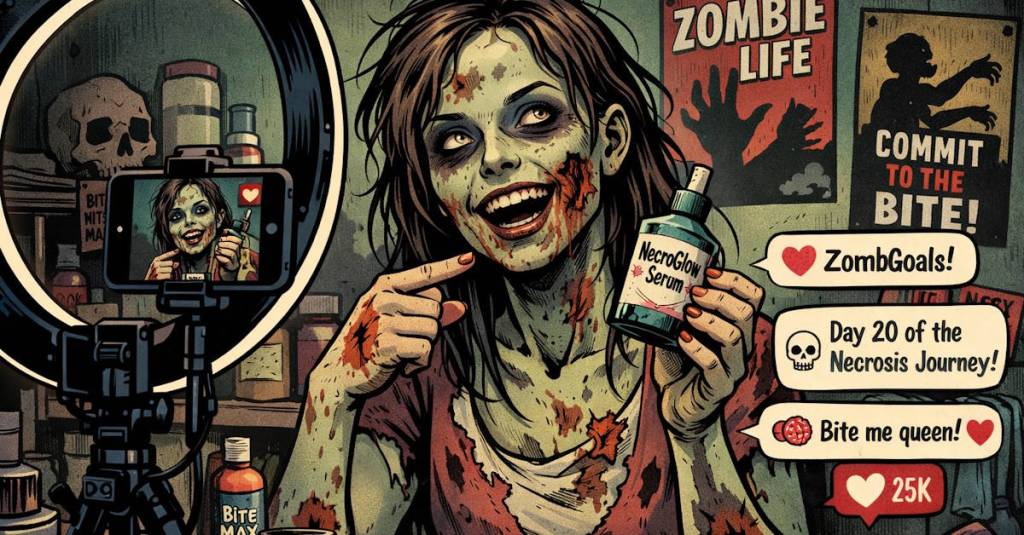
Influencers Promote the “Necrosis Journey”
The Romero Institute’s report identifies social media influencers as a major driver of the trend. Several popular zombmaxxing personalities have attracted large followings by documenting their supposed transformation into more convincing zombies.
One influencer known online as “DecayDerek” posts regular updates about what he calls his “necrosis journey” on TikTok. “People told me I’d never make it past Stage 2 decomposition,” he said in a recent video viewed more than 3 million times. “But look at me now. My skin tone is literally corpse-level.”
Another influencer, “ShambleQueen,” promotes what she calls the “slow pursuit lifestyle” through her YouTube channel. “Everyone’s always rushing around,” she said in a recent livestream. “But zombies know the secret: just move slowly toward your goals and eventually you’ll get there.”
She added that zombmaxxing had helped her achieve “better authenticity,” explaining, “I used to look like a normal human. Now strangers cross the street when they see me. That’s when you know you’re doing it right.”
According to Romero’s report, zombmaxxing influencers compete to be the “#1 Bub,” or the most undead-looking uber-zombie, based on voting on various online leaderboards. The influencers often attempt to undermine each other through “zogging,” a term derived from the acronym AZOG, or “Alpha Zombie of the Group.”
Romero’s researchers say zombmaxxing culture and its associated messaging can normalize increasingly extreme behavior. “These influencers frame zombification as a form of self-improvement,” DeMoro said. “But the biological reality is obviously quite different.”
Dangerous Myths About Zombification
The report also highlights misconceptions circulating within zombmaxxing communities, including that early-stage zombification improves facial structure, exposure to the zombie virus can be “controlled” through hydration and individuals can retain full cognitive function while partially undead.
“These claims are not supported by evidence,” DeMoro said. He explained that individuals exposed to the zombie virus consistently experience rapid declines in reasoning ability, impulse control and vocabulary. “In most cases, the victim’s conversation, at best, eventually devolves into the single word ‘brains.’”
The institute’s researchers also found no evidence that zombification improves dating success or career outcomes. “In fact,” DeMoro said, “once brain consumption begins, both social attractiveness and work productivity have been shown to decline sharply.”
Growing Concern Among Parents and Schools
Educators say the trend is beginning to show up in classrooms. Several schools across the country have reported incidents involving students practicing zombmaxxing behaviors in hallways and cafeterias.
“Last week we had a group of ninth graders pursuing the vice principal across the parking lot while groaning,” said one high school administrator who asked not to be named. “Fortunately, they were zombmaxxing as slow zombies, not rage zombies, so they never caught him.”
Parents have also expressed concern about the influence of zombmaxxing content. “My son used to want to be an astronaut,” said a Cedar Falls mother who asked to remain anonymous to protect her child. “Now he keeps talking about ‘optimizing his undead aesthetic.’”
She first became worried when her son began practicing what he described as “bite radius training” in the mirror. “He kept opening his mouth really wide and measuring it with a ruler,” she said. “That’s when I knew something was wrong.”
Early Warning Signs
The Romero Institute’s report encourages families to watch for early indicators that someone may be experimenting with zombmaxxing. Possible warning signs include:
- Sudden interest in decomposition-related content
- Posting “decomposition progress” selfies online
- Rating friends by their “snackability”
Another common indicator is a growing fascination with brains as a food category. “In many cases the shift is gradual,” DeMoro said. “First, it’s jokes about brains. Then it’s brain-themed snacks. Soon enough you’re dealing with a full outbreak.”
Scientists Urge Caution
Despite the alarming examples highlighted in the report, researchers stress that most zombmaxxing participants have not yet crossed the line into irreversible zombification. “This is still a preventable situation,” DeMoro said.
The Romero Institute recommends that individuals concerned about the trend avoid influencers encouraging viral exposure, maintain normal sleep schedules and nutrition, and seek medical advice or counseling before attempting any necrotization procedures.
“Most importantly,” DeMoro said, “people should understand that true zombification is not a lifestyle choice. It’s a medical condition, and it’s impossible to reverse.”
In addition, while zombmaxxing influencers often portray the undead lifestyle as empowering, researchers say the reality is far less appealing. “True zombies aren’t worried about optimizing their appearance, they’re worried about eating their friends and neighbors. That’s not a glamorous outcome,” DeMoro said.
Researchers say the best protections against zombmaxxing are critical thinking, media literacy and maintaining healthy human habits. “Eat regular food,” DeMoro advised. “Get adequate sleep. And if someone on the internet tells you to expose yourself to the zombie virus, maybe log off for a while and go for a hike.”
Enjoy educational zombie-related content? Subscribe to receive blog posts from the Bulletin of the Zombie Scientists in your Inbox or in the Reader app as they are published.
More Recent Posts
- “Zombmaxxing” Trend Putting Youth at Risk of Zombification, Researchers Warn
- Administration Weighs Deploying Undead to “Purify Woke Cities”
- President Fires Zombie Statistics Bureau Chief After Reported Rise in Undead Numbers
- Zombies of Different Generations Drawn to Different “Places of Meaning,” Study Finds
- “Z Visa” Program Would Let Wealthy Buy US Entry for Their Undead Relatives
Note: The Bulletin of the Zombie Scientists is a work of fiction. Any resemblance to persons (living, dead or living dead), actual organizations or actual events is entirely coincidental. See our About page and our Origin Story.
 Bulletin of the Zombie Scientists
Leave a comment