
By Bulletin Staff
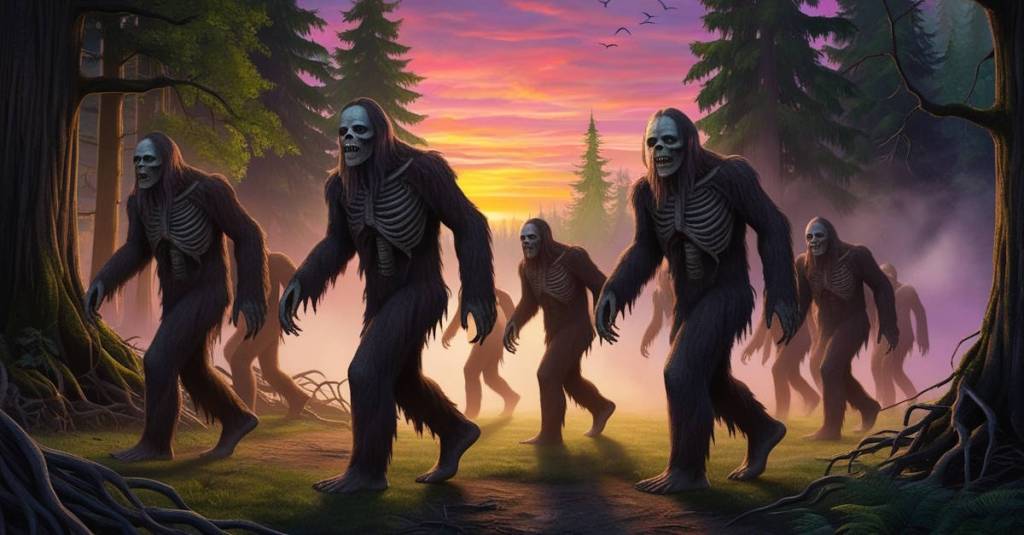
In the first of this two-part series, the Bulletin reported on a new Romero Institute report linking decades of Bigfoot sightings to an “undead megafauna” phenomenon. Part II of the series, below, looks at the potential impact of the “Zombfoot” theory on how the public enjoys wild spaces and the unsolved questions around Bigfoot’s true origins.
A New Perspective on Wilderness Risk
Perhaps the most controversial aspect of the report is its suggestion that Bigfoot may not simply be an isolated phenomenon, but part of a broader ecological system.
“The traditional model assumes that zombie outbreaks begin in populated areas and spread outward,” Varga said. “But it is equally plausible that remote environments serve as long-term reservoirs of undead activity.”
Under this model, Bigfoot would represent a persistent carrier population within forest ecosystems, with human encounters occurring when those environments are disturbed. This reframes the wilderness not as empty space, but as space that, in fact, is occupied in ways that we may not fully understand, Varga said.
Social Media and Risk Behavior
The report also notes a recent increase in individuals deliberately seeking out Bigfoot encounters, often documenting their efforts online. Dr. Kevin Hollis, a sociologist who studies high-risk behavior related to the undead, said this trend reflects a broader shift in how people engage with danger.
“We’re seeing individuals enter remote areas with minimal preparation in pursuit of what they perceive as a meaningful or shareable experience,” Hollis said. “In some cases, the possibility of an encounter is treated as a form of validation.
“It’s like Jackass with zombies,” he added, referring to the short-lived reality television show that featured a series of outrageous and seemingly dangerous stunts and pranks.
Hollis warned that this behavior could increase exposure to unknown risks. When people begin to treat ambiguous threats as content opportunities, he said, “the lines between curiosity, vulnerability and sheer stupidity become very thin.”
Origins Remain Elusive
Despite the report’s sweeping conclusions, the Romero researchers are careful to emphasize that one of the most fundamental questions remains unresolved: What Bigfoot is and how it might have become undead in the first place.
“We’ve made progress on classification, but we have not made comparable progress on origin. Those are two very different problems, and we would caution against conflating them,” DeMoro said.
The report outlines several competing hypotheses, none of which have been substantiated.
One possibility is that Bigfoot represents a previously unknown hominid population that underwent zombification at some point in the distant past. Under this model, the creatures observed today would be the remnants of an ancient lineage, one that experienced what researchers describe as a “persistent, self-sustaining necrological state.”
“That would imply a zombification event that did not burn out,” said Varga. “Most outbreaks we study are acute. They rise, they spread and they collapse. This would be something else entirely, something stable.”
Old-Growth Zombies?
Another theory proposes that Bigfoot is not the result of a single event, but an ongoing process. As yet unidentified environmental factors could be contributing to repeated instances of zombification within remote ecosystems that also are home to Bigfoot populations.
“We cannot rule out the possibility that certain environments facilitate reanimation, and those environments may be the most likely to host Bigfeet,” said Ruiz. “Forests, particularly old-growth systems, have long been associated with biological and chemical processes we do not fully understand and species that we have only just begun to discover.”
A third, more speculative framework suggests that Bigfoot may not have originated as a conventional organism at all. Some researchers have raised the possibility of cross-domain phenomena, including pathogens, environmental anomalies or other mechanisms that do not fit neatly within current biological models.
“We are operating at the edge of multiple disciplines,” Ruiz said. “Virology, ecology, neurology, even physics. When you encounter a system that resists explanation from any single field, it’s often a sign that you’re missing a piece of the puzzle or several pieces.”
The Romero researchers stress that the absence of an origin model does not invalidate the observational data. “It is entirely possible to recognize a pattern without fully understanding its source,” said Nandakumar. “We know how these entities behave. We do not yet know why they exist.”
Calls for Further Research
The authors of the Romero Institute’s report call for increased funding and expanded field studies to further investigate and better understand the Zombfoot phenomenon. While the report stops short of making definitive claims, its authors argue that the current evidence warrants serious consideration.
“We’re not saying this is the final answer,” DeMoro said. “We are saying that the existing framework is no longer sufficient.”
He added that a shift in perspective may be necessary to make progress. “For years, the question has been, ‘Why can’t we find Bigfoot?’ It may be time to ask a different question: ‘Why does Bigfoot keep appearing to us and in the same unresolved state?’”
Public Safety Guidance
In the meantime, researchers recommend a cautious approach to wilderness exploration in areas traditionally associated with Bigfoot. “Encounters remain rare,” Nandakumar said. “But rarity is not the same as impossibility.”
The report advises hikers and outdoor enthusiasts to travel in groups, remain aware of their surroundings and avoid interpreting unusual activity as benign without further evidence. “People often assume that if something hasn’t been proven, it can’t be dangerous. That assumption has not historically worked out well,” Nandakumar said.
While the idea of an undead Bigfoot may strike some as unlikely, the report’s authors argue that dismissing the possibility outright would be premature. “The history of science is full of ideas that seemed implausible until they weren’t,” DeMoro said. “Our responsibility is to follow the data, even when it leads us somewhere unexpected.” For now, the question of Bigfoot’s true nature remains unresolved. But if the Romero Institute’s findings gain traction, the mystery may be entering a new, considerably more unsettling phase.
Enjoy educational zombie-related content? Subscribe to receive blog posts from the Bulletin of the Zombie Scientists in your Inbox or in the Reader app as they are published.
More Recent Posts
- Bigfoot or “Zombfoot”? Sasquatch May Be Undead, Study Suggests – Part II
- Bigfoot or “Zombfoot”? Sasquatch May Be Undead, Study Suggests – Part I
- “Zombmaxxing” Trend Putting Youth at Risk of Zombification, Researchers Warn
- Administration Weighs Deploying Undead to “Purify Woke Cities”
- President Fires Zombie Statistics Bureau Chief After Reported Rise in Undead Numbers
Note: The Bulletin of the Zombie Scientists is a work of fiction. Any resemblance to persons (living, dead or living dead), actual organizations or actual events is entirely coincidental. See our About page and our Origin Story.
 Bulletin of the Zombie Scientists
Leave a comment