
By Bulletin Staff
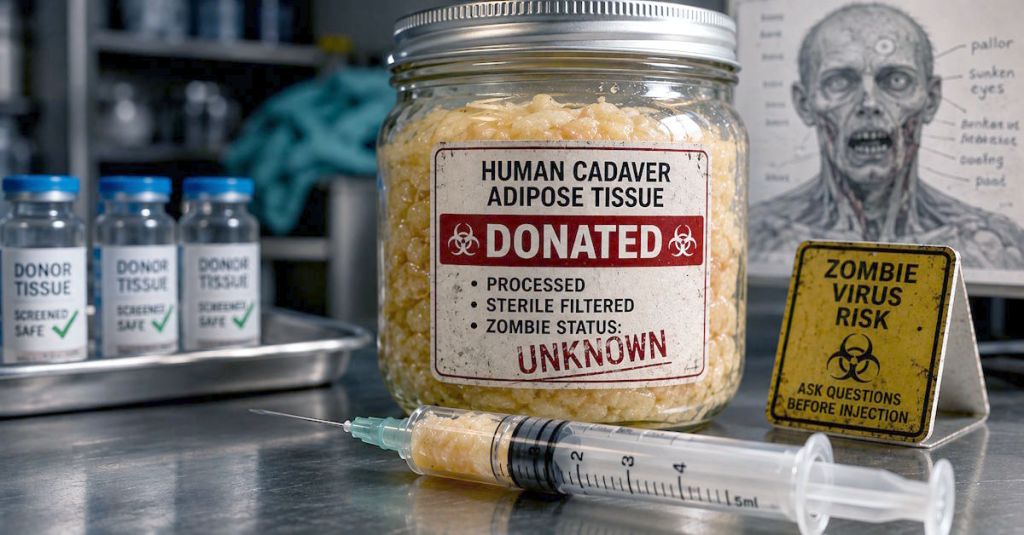
A cosmetic procedure popularly known as “zombie filler” is gaining attention as a way for patients to restore lost facial and body volume by injecting fat obtained from human cadavers. But zombie researchers are warning that the procedure could carry a largely overlooked risk: actually turning patients into zombies.
As reported recently by USA Today, “zombie filler” involves injecting processed fat obtained from donated human cadavers rather than transferring a patient’s own fat from another part of the body. The procedure has become increasingly attractive to people who have too little body fat to undergo a conventional fat transfer, including some patients who have experienced significant weight loss while taking GLP-1 medications.
The name, of course, refers to where the fat comes from, not what it is supposed to do to the recipient. But researchers at the National Institute for Undead Pathology (NIUP) say the distinction may not always be quite so clear.
In a report released this week, NIUP researchers identified 11 cases over the past three years in which people developed symptoms of zombification after receiving cosmetic injections of cadaver-derived fat. In seven of the cases, investigators were able to trace the donor tissue to people who had been infected with a zombie virus before they died.
“We have traditionally thought about zombie-virus transmission in terms of bites, scratches or direct contact with infected bodily fluids,” said Dr. Melissa Cadwell, an infectious disease specialist with the NIUP and lead author of the study. “What these cases suggest is that infected tissue introduced directly into the body may represent another transmission pathway.”
Undead Fat May Remain Infectious
The NIUP study focused on whether zombie viruses can survive in adipose tissue after death and whether the processing of donated tissue is sufficient to eliminate them.
The researchers tested fat samples obtained from 34 zombies that had been destroyed during outbreaks in Pennsylvania, Ohio and New Jersey. Viable zombie virus was detected in 21 of the samples, including in tissue collected as long as 18 days after the zombie had been destroyed.
More troubling, the researchers found that some of the virus remained viable after the tissue was subjected to processing methods similar to those used in preparing donated fat for medical purposes.
Cadwell said adipose tissue appears to provide a particularly hospitable environment for some zombie viruses. “Fat can preserve certain viral particles surprisingly well,” she said. “Unfortunately, that appears to include undead viral particles.”
The researchers stressed that the zombie tissue used in the experiments was obtained specifically for research and did not enter the human tissue supply. “We should be very clear about that,” Cadwell said. “We were not injecting zombie fat into unsuspecting people to see what happened.”
From Fuller Cheeks to a Hunger for Brains
The research began after several cosmetic surgeons reported unusual medical problems among patients who had received cadaver-derived filler.
One case involved a 47-year-old California woman who received donor fat to restore volume to her cheeks after significant weight loss. According to the report, she initially was pleased with the results and experienced no unusual side effects during the first two days after the procedure.
On the third day, she developed a low-grade fever and complained of fatigue. Her skin became noticeably pale and she began having difficulty speaking. By the fifth day, according to family members interviewed by investigators, she had become aggressive and attempted to bite her husband.
The woman subsequently was diagnosed with Stage III zombie virus infection and transferred to a secure containment ward for neutralization.
Investigators traced the fat used in her procedure to a 63-year-old donor who had died from cardiac arrest. Nothing in his medical records indicated that he had been infected with a zombie virus.
But family members later told investigators that the man had been bitten during a small zombie outbreak at a shopping mall nine days before his death. He did not seek medical treatment because the bite apparently had not broken the skin, and he showed no obvious symptoms of infection before suffering the fatal heart attack.
Postmortem testing of preserved tissue samples subsequently detected traces of zombie virus.
Cadwell said the case highlights a potential hole in the screening process. “A person doesn’t necessarily have to die from a zombie infection to be carrying the virus when they die,” she said. “If nobody knows about the exposure, there may be no reason for a tissue bank to test for it.”
Screening Standards Questioned
Human tissue donors already are screened for a number of infectious diseases and medical conditions before donated material can be used for transplantation and other medical procedures. Zombie-virus screening, however, is not routinely required for all donated adipose tissue.
Part of the problem is the large number of zombie-virus strains that have been identified and the lack of a standardized screening test capable of detecting all of them.
The Food and Drug Administration’s Office of Undead Infection said it is reviewing the NIUP findings and consulting with tissue banks, cosmetic surgeons and zombie researchers about whether changes to current screening standards are necessary.
“The available evidence suggests that the risk of zombie-virus transmission through properly screened and processed human tissue remains extremely low,” the agency said in a statement. “Nevertheless, any preventable case of zombification associated with a medical or cosmetic procedure is a matter of concern.”
The agency did not recommend that people cancel procedures involving donated human tissue.
Cosmetic Surgeons Say Risk Is Low
Cosmetic surgeons also cautioned against overreacting to the report. Dr. Jacqueline Fulmer, president of the American Society for Regenerative Aesthetic Medicine, pointed out that thousands of procedures involving donated human tissue are performed every year without patients turning into zombies.
“We understand that the phrase ‘zombie filler,’ combined with a report about actual zombies, is going to get people’s attention,” Fulmer said. “But the overwhelming majority of people who receive these products do not become zombies.”
Fulmer said the organization would support additional screening if there is evidence that it would reduce the risk of transmission.
Some clinics aren’t waiting.
Three Beverly Hills cosmetic practices contacted by The Bulletin said they now offer patients what they describe as “certified zombie-free” donor tissue, although there currently is no government certification for the term.
One clinic said its premium donor fat comes only from individuals who tested negative for known zombie viruses and had no documented contact with the undead during the 30 days before death.
Another advertises that all of its donors were “fully and continuously deceased” between the time they were pronounced dead and the recovery of their tissue.
Who Pays for Zombie Testing?
The NIUP report recommends that tissue banks expand their screening of donors to include questions about possible contact with zombies in the weeks before death. It also recommends laboratory testing of donated adipose tissue for common strains of zombie virus.
The tissue-processing industry has raised concerns about the proposals, arguing that additional testing would increase costs and could reduce the amount of donor tissue available.
The American Association of Human Tissue Processors estimates that comprehensive zombie-virus screening could add $400 to $900 to the cost of a cosmetic procedure.
“There has to be a rational assessment of risk,” association spokesperson Douglas Stern said. “We cannot design the entire tissue-donation system around the theoretical possibility that every dead person might actually be undead.”
Cadwell said that isn’t what the researchers are proposing. “Every cadaver isn’t a zombie,” she said. “But every zombie is a cadaver. Our concern is making sure we can tell the difference before part of that cadaver is injected into somebody else.”
The Undead Look
Whether the report will discourage people from getting zombie filler remains to be seen.
In fact, the publicity surrounding the study appears to have generated more interest in the procedure. Posts about zombie filler have proliferated on social media, including videos joking about getting an “undead glow” or the sharply defined facial features associated with advanced zombification.
One video viewed more than 1.8 million times offered purported tips for achieving “zombie cheekbones” without going “full zombie.”
Doctors say this is not a good idea. “There is absolutely no evidence that a low-level zombie infection has any cosmetic benefit,” said Dr. Rebecca de Morgue, a dermatologist and zombie-medicine specialist at the University of Northern California Medical Center.
De Morgue said zombification can cause dramatic changes in facial appearance, particularly during later stages of infection. But those changes are caused largely by dehydration, tissue necrosis, muscle deterioration and decomposition. “That can certainly make the cheekbones more prominent,” she said. “It doesn’t make it a beauty treatment.”
And any benefits are likely to be short-lived. “Eventually your nose falls off,” de Morgue said.
What Patients Should Know
For now, NIUP researchers recommend that anyone considering a procedure using donated fat ask their doctor where the tissue comes from and whether the donor was screened for zombie-virus exposure.
Patients also should make sure that the tissue comes from a licensed supplier and ask whether the processor has procedures for identifying donors who may have lived in an area experiencing a zombie outbreak.
Researchers emphasized that people who already have received zombie filler should not assume that they have been exposed to the virus.
However, anyone who experiences unexplained fever, gray or deteriorating skin, confusion, difficulty speaking, aggressive behavior or an unusual urge to bite other people following a procedure should seek medical attention. A sudden craving for human brains also warrants immediate medical evaluation.
Cadwell said the researchers do not want their findings to discourage the legitimate medical use of donated human tissue. “Cadaver-derived tissue has many important medical applications, and there is no reason to believe that properly screened tissue poses a significant zombie risk,” she said. “But if we’re going to move fat from a dead person into a living person, it seems reasonable to make sure the donor really was just dead and not undead.”
Enjoy educational zombie-related content? Subscribe to receive blog posts from the Bulletin of the Zombie Scientists in your Inbox or in the Reader app as they are published.
More Recent Posts
- Could AI Engineer the Next Zombie Virus? Biosecurity Experts Warn of Growing Risk
- “Zombie Filler” May Turn Cosmetic Patients into Actual Zombies, Researchers Warn
- Zombsday Clock Advances to 66 Seconds to Midnight
- Bigfoot or “Zombfoot”? Sasquatch May Be Undead, Study Suggests – Part II
- Bigfoot or “Zombfoot”? Sasquatch May Be Undead, Study Suggests – Part I
Note: The Bulletin of the Zombie Scientists is a work of fiction. Any resemblance to persons (living, dead or living dead), actual organizations or actual events is entirely coincidental. See our About page and our Origin Story.
 Bulletin of the Zombie Scientists
Leave a comment