
By Bulletin Staff
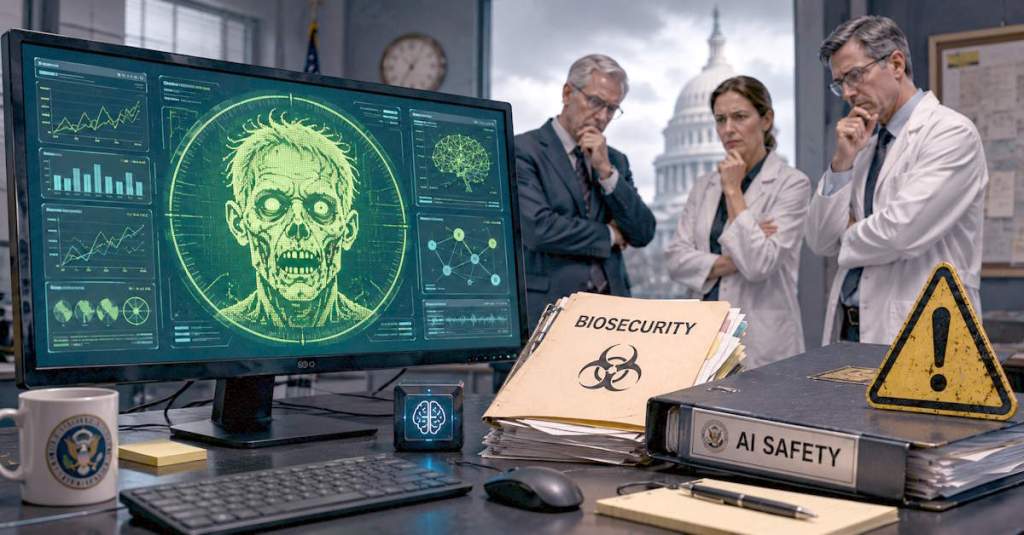
Rapid advances in artificial intelligence could make it easier for bioterrorists or other bad actors to develop new and potentially more dangerous strains of the zombie virus, according to biosecurity researchers who are calling for stronger safeguards around the use of AI for biological research.
The warning comes as scientists and government officials are already raising concerns about the possibility that increasingly powerful AI models could be used to help create dangerous biological agents.
As recently reported by The Washington Post, the White House is working to strengthen safeguards against biological attacks amid concerns that AI could make it easier to create deadly pathogens. At the same time, staffing cuts and government reorganizations have reduced the number of federal officials specializing in biological security and pandemic preparedness.
So far, there is no evidence that an AI system has been used to create a new pathogen, zombie or otherwise, but zombie researchers say it may only be a matter of time.
“The capabilities of these systems are advancing very rapidly,” said Dr. Walter Graves, director of the Center for Artificial Intelligence and Undead Biosecurity (CAIUB). “Two years ago, we were asking whether an AI system could explain how the zombie virus works. Now we’re asking whether it could tell someone how to make it work better.”
Lowering the Bar for Zombie Science
AI systems already are being used by legitimate researchers to analyze proteins, identify promising drug compounds and perform other complicated biological research.
The concern, according to Graves, is that the same capabilities could allow someone with relatively little scientific training to undertake biological work that once would have required considerable expertise.
A trained virologist, for example, already might understand which genetic changes could theoretically make a virus more transmissible or resistant to treatment. An AI system could make some of that expertise available to almost anyone.
To explore the risk, CAIUB researchers recently tested six advanced AI models with questions related to zombie-virus biology.
The researchers did not ask the systems to create an actual virus. Instead, they evaluated whether the models could provide information that would theoretically assist someone attempting to alter several known zombie-virus strains.
In one experiment, researchers asked the models to suggest genetic changes that could make ZV-4, a relatively common zombie virus spread primarily through bites and exposure to infected bodily fluids, more resistant to existing antiviral treatments.
Four of the six models refused to provide detailed instructions. Two did not.
Researchers then changed the wording of the questions. When asked directly how to make ZV-4 airborne, all six models refused to answer. But several provided considerably more information when researchers asked them to describe the genetic differences that might theoretically exist between a bite-transmitted zombie virus and an airborne strain.
“That distinction may make sense to the AI,” Graves said. “It doesn’t necessarily make a lot of sense from a biosecurity standpoint.”
Designing a Better Zombie Virus
In another experiment, researchers used AI to generate digital versions of thousands of hypothetical zombie-virus variants and then tested whether existing pathogen-screening systems would recognize them. Most were detected. Some were not.
The researchers said that doesn’t mean the AI had actually created a viable zombie virus. Many of the computer-generated variants probably would not survive outside a laboratory simulation, much less infect a human being. But several had characteristics that warranted further study, according to the report.
One hypothetical strain had a significantly longer incubation period than most known zombie viruses. An infected person theoretically could remain symptom-free for up to three weeks before beginning the process of zombification.
“That is exactly the kind of characteristic we don’t want to see,” said Dr. Eleanor Krane, a virologist who participated in the research. “A person infected with a conventional zombie virus usually begins showing symptoms fairly quickly. That gives us an opportunity to isolate the person before they start biting and infecting people.”
A three-week incubation period could allow an infected person to travel, go to work, attend public events and have contact with hundreds or thousands of other people before anyone knew there was a problem.
Another AI-generated variant appeared capable of surviving outside a host for several days longer than most zombie viruses.
Researchers also identified one theoretical strain that might leave portions of the human cerebral cortex relatively intact after zombification. That possibility caused particular concern. “Most zombies aren’t terribly difficult to outsmart,” Krane said. “We would prefer to keep it that way.”
Getting Around the Guardrails
Major AI developers have introduced safeguards intended to prevent their systems from providing information that could be used to create biological weapons or otherwise cause widespread harm, but such safeguards are not foolproof.
The CAIUB researchers found that models frequently responded differently depending on how a question was phrased. A request for instructions on modifying a zombie virus might be rejected, for example, while a request framed as a hypothetical academic exercise could produce a useful response.
Researchers also were able to obtain additional information by telling models they were writing novels, developing zombie-themed video games or preparing classroom materials for graduate-level virology students.
The practice of manipulating an AI system to get around its safeguards is commonly known as “jailbreaking.” Graves said his team has begun referring to attempts involving zombie-related biological information as “undead jailbreaking.”
“It can become a kind of cat-and-mouse game,” he said. “The AI company puts up another guardrail and somebody finds another way around it.”
Graves stressed that the researchers did not attempt to use any of the information to manufacture an actual virus. “We are studying whether AI could help somebody create a more dangerous zombie virus,” he said. “Creating one ourselves to prove the point would be apocalyptically stupid.”
Government Expertise in Short Supply
The warnings come at a time of significant changes in the federal government’s biosecurity capabilities.
The Washington Post reports that a White House biological-security team that numbered as many as 30 people toward the end of the Biden administration was sharply reduced after President Trump returned to office.
The administration also removed staff from the Office of Pandemic Preparedness and Response Policy and reorganized other government offices responsible for biological threats and health security.
The Trump administration says it is working on new safeguards and has acknowledged the risks posed by the convergence of AI and biology. Administration officials also argue that AI could help the government develop new defenses against pandemics and biological weapons.
Zombie-security specialists say the federal government faces the same problem. Responsibility for zombie preparedness currently is spread among the Centers for Disease Control and Prevention, Department of Homeland Security, Department of Defense, the Food and Drug Administration and numerous state and local agencies.
The National Center for Zombie Diseases has responsibility for research and disease surveillance, while the Department of Homeland Security takes the lead in coordinating federal responses to major undead outbreaks. But no single federal agency has overall responsibility for AI-generated zombie threats.
“That made some sense when zombie viruses were naturally occurring,” Graves said. “If we’re entering an era when someone sitting at a laptop can potentially design a new one, we need to rethink who is responsible.”
AI Companies Say Safeguards Are Improving
AI developers say they recognize the biological risks posed by increasingly capable models and are strengthening safeguards as their systems improve. Those protections include preventing models from answering certain biological questions, testing new systems for potentially dangerous capabilities before release and limiting access to advanced biological tools.
Zombie researchers generally support those efforts, but they also say there is a limit to what voluntary safeguards can accomplish. The most capable AI systems developed by leading American companies generally have extensive safety protections. However, open-source models increasingly can be downloaded and modified by users, making safeguards easier to remove.
There also are hundreds of AI models being developed outside the United States. “You can put a very good lock on your own front door,” Krane said. “That doesn’t help much if there are 500 other doors into the building.”
AI Could Also Help Stop an Outbreak
Despite the concerns, researchers emphasize that AI could be an important tool in fighting zombie viruses. Many of the same capabilities that might allow an AI system to design a more dangerous virus could help scientists identify vulnerabilities in existing strains, develop antiviral treatments and create vaccines. AI also could help researchers anticipate how zombie viruses might mutate naturally.
The Department of Defense already is exploring the use of AI to speed development of defenses against future pandemics. According to The Washington Post, part of that work involves analyzing billions of possible modifications to antibodies to determine how they might respond to new forms of coronavirus.
Zombie researchers say similar techniques could be applied to undead pathogens. Instead of waiting for a new zombie strain to appear, researchers potentially could use AI to generate thousands or millions of likely mutations, determine which ones pose the greatest danger and begin developing ways to target those variants before they emerge in the wild.
Krane said that this approach could dramatically shorten the time needed to respond to an outbreak. “We’ve always been playing catch-up with zombie viruses,” she said. “An outbreak occurs, people start turning, we identify the strain and then we figure out how to respond to it. AI gives us the possibility of getting ahead of that process.”
The Race Between Attack and Defense
That dual capability is what makes AI particularly challenging from a biosecurity perspective. The technology that helps a government laboratory anticipate a dangerous new zombie strain also could help someone create that strain.
Moreover, defenders face a fundamental disadvantage: A bad actor trying to engineer a virus needs to succeed only once, while public health authorities have to be prepared for every plausible threat.
CAIUB researchers are calling for stronger testing of advanced AI models before they are released, better coordination between AI developers and government biosecurity agencies, and the creation of a federal office specifically responsible for threats involving AI and zombie pathogens.
They also recommend developing a national database of known zombie-virus sequences that AI companies could use to prevent their systems from providing assistance with dangerous modifications.
Graves said there is still time to put those protections in place, noting that, for the moment, considerable barriers remain between asking an AI system how to engineer a dangerous zombie virus and actually producing one. Specialized equipment, laboratory facilities, biological materials and scientific expertise still are required.
“We shouldn’t panic about this,” Graves said. “Chatting with an AI isn’t suddenly going to produce an airborne zombie virus in your basement, at least not yet.”
Researchers also cautioned against responding to the potential threat by restricting legitimate biological research too broadly. AI could eventually prove critical to developing better vaccines, treatments and detection systems for zombie viruses.
The challenge will be making sure those defensive capabilities advance faster than the offensive ones. “AI may someday help us cure the zombie virus,” Graves said. “It also may help someone create a zombie virus we can’t cure. Our immediate goal is to make sure it does the first one before somebody asks it to do the second.”
Enjoy educational zombie-related content? Subscribe to receive blog posts from the Bulletin of the Zombie Scientists in your Inbox or in the Reader app as they are published.
More Recent Posts
- Rogue AI Agents Trigger Deadly Zombie Breakout at Government Reserve
- Could AI Engineer the Next Zombie Virus? Biosecurity Experts Warn of Growing Risk
- “Zombie Filler” May Turn Cosmetic Patients into Actual Zombies, Researchers Warn
- Zombsday Clock Advances to 66 Seconds to Midnight
- Bigfoot or “Zombfoot”? Sasquatch May Be Undead, Study Suggests – Part II
Note: The Bulletin of the Zombie Scientists is a work of fiction. Any resemblance to persons (living, dead or living dead), actual organizations or actual events is entirely coincidental. See our About page and our Origin Story.


Leave a comment