
By Bulletin Staff
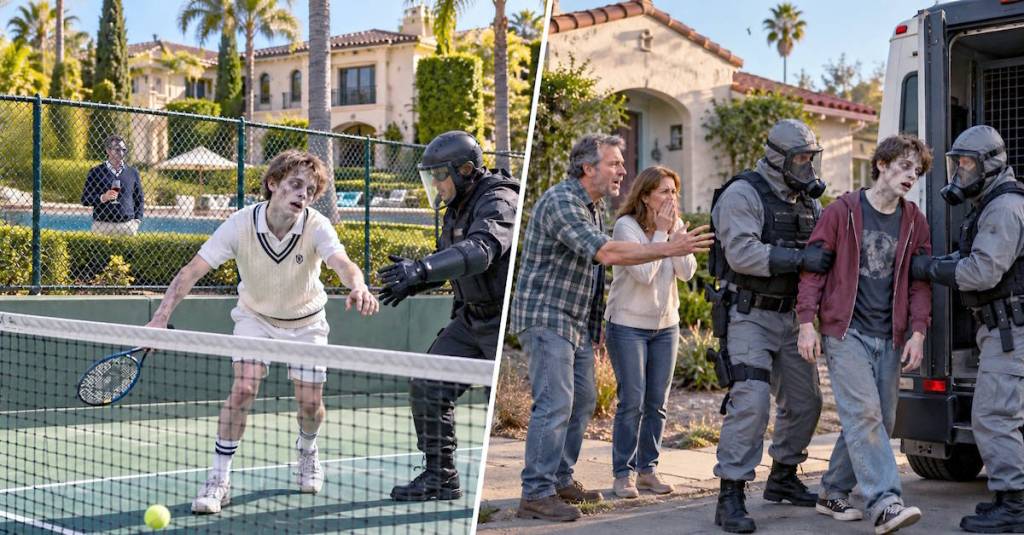
On a recent cool afternoon in Beverly Hills, hidden from prying eyes by 10-foot fencing and 12-foot hedges, a young male zombie ambles about a private tennis court, pursuing its “coach” from one side of the net to the other.
Standing safely behind the chain-link barrier enclosing the hardcourt, Byron Regan calls to the zombie, who in life was Regan’s son. “Blane! Blane! Chase the balls, not your coach!”
Regan, who made a fortune in private equity before launching a second career as a Hollywood producer, tells a visitor to his mansion on North Roxbury Drive that his son was a talented tennis player, recruited by top-tier colleges, prior to zombification.
“His arm was like a rocket, just lobbing cannonballs across the net,” Regan says. “Now…” His voice trails off, and he turns away to dab a tear from beneath his Tom Fords.
Right now, Blane has become tangled in the net, and his coach, wrapped in bite-proof leather protective gear, is trying to free the young Regan scion to “play” another “set.”
The senior Regan takes a long draw from his glass of grand cru Burgundy and sighs. “If it weren’t for the waiver,” he says, “we’d have lost Blaney to the incinerator.”
“Necro Baby Exception”
Following his zombification in 2025, Blane Regan was a recipient of the so-called “compassionate family preservation waiver” (CFPW), more widely known (and often derided) as the “necro baby exception.”
Congressional Republicans included the waiver program in last year’s “One Big Beautiful Bill” at the insistence of President Donald Trump, who said that the undead exceptions were needed to ensure that “the very talented zombified children of our country’s most successful people can continue to make America great again.”
Under the legislation, the Department of Homeland Security created an Office of Undead Family Reunification to issue the waivers in cases “where a family is able to demonstrate that the zombified youth possesses exceptional talents or has the potential to make positive contributions to society.”
Families that receive a waiver are permitted to continue living with their undead offspring once they put certain containment measures in place to protect themselves and the public from risk of bite and infection.
Byron Regan paid the $100,000 application fee on behalf of his son and hired the white-shoe law firm of Rott & DeKay to shepherd the application through the DHS review process. “It wasn’t cheap,” Regan admits, “but it’s worth it to keep my boy out of the government’s furnace.”
No Time to Mourn
While Blane Regan got in its reps on the court with its coach, on the other side of Beverly Hills, both geographically and economically, south of Olympic Boulevard, Lawrence “Big Larry” Cherkins Senior was showing a visitor pictures of his son, Lawrence “Little Larry” Cherkins Junior.
The Cherkins’ stucco Spanish Revival home squeezes in between the duplexes and four-plexes lining their street. “Big Larry” is the office manager for an architectural business in nearby Century City.
Flipping through the photo app on his phone, Big Larry shows his son before zombification, cheering on his high school’s football team at a game last November, hugging his grandmother at a family birthday gathering, volunteering at their church’s bake sale and riding a wave at El Porto in Manhattan Beach.
“He was a good kid. A good kid…” Big Larry says, his voice quavering and trailing off.
Little Larry was attending an all-ages concert of the SoCal punk band Jerk and the Strains at the Rhodium Theatre on Sunset last December when he was bitten by an infected fellow concertgoer. He turned two days later, and government agents immediately took him into custody and scheduled his incineration for the following week.
Larry Senior says that he wanted to apply for the CFPW program and even set up an online fundraising campaign to collect the $100,000 fee. But without a team of lawyers to steer the family through the application process, Little Larry was reduced to ash before the Cherkins could hit their fundraising goal.
“They wouldn’t even give us his remains so we could mourn him properly,” Cherkins says.
Controversy over Program
Critics of the CFPW program have pointed out that, while DHS theoretically makes waiver decisions without consideration of a family’s income, in reality recipients of the necro baby exception have come overwhelmingly from the so-called “1 percent” of upper-income households.
“The program is technically income-neutral, but it’s been wildly unequal in practice,” said Ravi Devi, director of the Institute for the Undead and the Law at Penningsworth College, who has studied the demographics of the undead accepted into the program.
“DHS insists that wealth plays no role whatsoever in CFPW decisions, but our review found that 94 percent of successful applicants come from households earning more than $1 million, and 96 percent attended private schools before zombification,” Devi said.
“The government doesn’t actually say rich zombies deserve to live and poor zombies deserve to be destroyed,” Devi added. “It simply created a system in which proving that your undead offspring deserves to live costs hundreds of thousands of dollars.”
Which Zombies Are “Exceptional”?
Angela Witchcoven, program leader at the Committee for Undead Equality (CUE), a nonprofit that advocates for humane treatment of the zombified, has critiqued the CFPW’s vague definition of what qualifies as “exceptional talent.”
“DHS has very broad discretion to decide whether a given applicant has the potential to make positive contributions to society, and that opens up the possibility of very arbitrary outcomes,” Witchcoven said.
In a report released last month, Witchcoven’s Committee cited what it called “egregious examples of preference shown to ‘privileged’ waiver applicants.”
For instance, a studio executive’s son qualified because he had 800,000 TikTok followers prior to infection, and the daughter of an unidentified senator received a waiver because she had been accepted to Yale.
In another case, a hedge-fund manager’s zombified daughter received a waiver because she had been a nationally ranked equestrian. After she became one of the unholy dead, the daughter killed and ate several horses and at least one stablehand in the family stables, the CUE report noted.
On the other hand, achievements like Larry Cherkins Junior’s scholastic record and his civic participation do not appear to have factored into any successful waiver application. DHS records reviewed by CUE suggested that no applicant has yet received a waiver for being “a good kid.”
The High Cost of Containment
Advocates for the CFPW program say the high cost of keeping zombified children safely isolated from the living justifies granting waivers predominantly to families of means.
Estimates of the cost of safe containment vary, but experts put the initial investment in setting up a home containment site to meet government standards at between $350,000 and $550,000. Ongoing costs can add up to hundreds of thousands of dollars annually.
In fact, a whole luxury necro-child industry has developed in the wake of the program, including residential containment architects, bite-proof clothing designers, private handlers or “coaches,” undead behavioral therapists and even elite schools offering “post-vital inclusion programs.”
“The sky’s the limit on how much you can spend to keep your little rotter in your life,” said Delia Zimbowski, CEO of SafeDead, a company that coordinates after-life care for the zombified children of high-net-worth families. “I mean, you can’t just keep the kid in a pit in your backyard or stashed in your garage.”
The Bulletin reached out to DHS for comment on the controversy surrounding the program. In an emailed response, a spokesperson rejected suggestions that the CFPW favors wealthy families, noting that neither household income nor net worth is considered in determining eligibility.
“Every American family has the equal opportunity to pay the $100,000 application fee, retain qualified counsel, construct an approved containment facility and demonstrate its undead child’s exceptional potential,” the spokesperson said, adding, “It’s completely meritocratic.”
“Not a Necro Baby”
For his part, Byron Regan rejects the accusation that his son received any preferential treatment. “Blane is not a necro baby. Nobody handed him anything. He earned that waiver,” Regan says while watching his son claw and gnash its teeth at its coach from across the net on the family’s private tennis court.
The parents of another waiver recipient, who requested anonymity to speak with The Bulletin, acknowledged that their undead daughter had some advantages weighing in her favor, but they insisted that this shouldn’t diminish the zombie child’s accomplishments.
“Yes, we hired three former DHS officials, two epidemiologists and a crisis-communications firm to help guide our daughter through the process, but, ultimately, Madison had to demonstrate her own potential,” the undead girl’s mother said.
Back at the Cherkins’ home, Big Larry is still scrolling through photographs on his phone. He tells the visitor that he doesn’t begrudge parents who are able to secure a waiver for their dear departed. He just wishes he’d had the resources to save Little Larry, too. “If my lottery numbers had come through, I would have done exactly the same thing for my son,” Cherkins says. “It just wasn’t my week. Or Larry Junior’s.”
Enjoy educational zombie-related content? Subscribe to receive blog posts from the Bulletin of the Zombie Scientists in your Inbox or in the Reader app as they are published.
More Recent Posts
- Necro Babies: Are Some Undead Children More Equal than Others?
- Rogue AI Agents Trigger Deadly Zombie Breakout at Government Reserve
- Could AI Engineer the Next Zombie Virus? Biosecurity Experts Warn of Growing Risk
- “Zombie Filler” May Turn Cosmetic Patients into Actual Zombies, Researchers Warn
- Zombsday Clock Advances to 66 Seconds to Midnight
Note: The Bulletin of the Zombie Scientists is a work of fiction. Any resemblance to persons (living, dead or living dead), actual organizations or actual events is entirely coincidental. See our About page and our Origin Story.


Leave a Reply